Showing posts with label CAR review. Show all posts

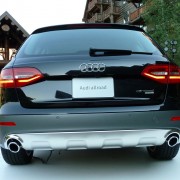
Audi allroad Review 2013

Posted by Blogger Kingdom 0 comments


By Judy Colman

The hills around Denver, Colorado were alive with music, but not with the voices of the von Trapp family. This music emanates from the humming engines of Audi’s eighth version of their ‘B’ Segment lineup – the Audi A4, S4, A5, S5 and, again, the Audi allroad.
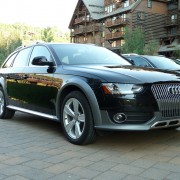
For 2013, Audi reintroduces the allroad, last available in the US in 2005. This new version replaces the A4 Avant in Audi’s model line. Now based on the A4 platform rather than the A6, the new allroad is faster and more energy efficient than its predecessor. A 211 horsepower, 2.0-liter, direct-injection I4, turbocharged engine provides plenty of oomph to tackle the Rockies while still delivering 23 (combined) mpg. 258 lb.-ft. of torque are generated at 1500 rpm. Audi links the 2.0T motor with an eight –speed Tiptronic automatic transmission. A manual transmission is not currently available. We tested quattro, Audi’s permanent all-wheel drive system, when afternoon thunderstorms all but obliterated the roadway. Grip on the slick, mountain curves never wavered on the standard 18-inch wheels shod with 245/45 all season tires.
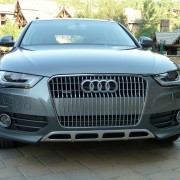
The 2013 allroad receives the distinctive Audi “Singleframe” grille with vertical chrome struts and angled upper corners. That feature appears also on all ‘B’ Segment cars for a homogeneous look. Newly designed headlamps, fog lamps, side mirrors, taillights, and exhaust add to the fresh appearance. The new allroad’s longer wheelbase adds ride comfort and an additional 1.5 inches of ground clearance. That and a widened track makes off road trekking a little easier. Body cladding, traditionally a matte finished gray/black is also available in full paint finish.

Technology abounds in the 2013 allroad. If you are travelling at less than 19 mph, the Audi Adaptive Cruise Control system can fully stop the car if it senses a collision. An electromechanical power steering system, Audi Dynamic Steering, replaces a traditional hydraulic system. It requires no additional energy from the engine, if it is travelling in a straight line, and thereby reduces emissions. Factory installed wireless internet, called Audi Connect, a 3G online connection, is now available on the allroad as well as all ‘B’ Segment models. Paired with Audi’s MMI Navigation, Google Earth maps will be joined in 2013 with Google’s street view technology. While you’re busy looking at the mountain scenery, your tech-obsessed passengers can take full advantage of their electronic toys. Your allroad is now a Wi-Fi hotspot capable of connecting up to 8 devices. Who said the hills aren’t alive with music, and games, and movies, and texting?
Despite the fact that the 2013 allroad is now based on the smaller A4 platform, overall height increases by 2.3 inches offering more front passenger headroom than in previous models. Driver seat memory, heated front seats, a panorama sunroof, and an available sports interior package welcome passengers. The revised instrument cluster looks modern and crisp. Fold down the 40/60 split rear seat and load the 50.5 cu. ft. of cargo space with everything you need for your mountain adventure. Interior design is sophisticated and refined. Standard leather seating alone puts allroad ahead of its rivals, notably the BMX 328i xDrive and the larger Volvo XC70.

Three trim levels of the 2013 allroad are available: the Premium starting at $39,600, the Premium Plus starting at $42,900, and the Prestige model at $48,800.
Because the 2013 allroad has few competitors in the market, Audi is betting the American public is again ready for this revised version. As an alternative to the crossover or small SUV, the Audi should appeal to anyone needing a little extra space without compromising handling and comfort. The hills may not be alive with “Do-Re-Mi” but maybe with a little Zac Brown Band, or Black-Eyed Peas, or the sweet sound of a 2.0T motor humming up a mountain pass.
BMW 650i Coupe Review 2012

Posted by Blogger Kingdom 0 comments


By David Colman
For: Do-It-All Nature, Space, Grace, Pace
Against: Exterior Rear View Mirrors Too Small
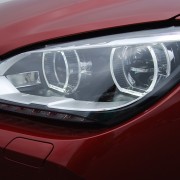
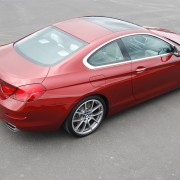
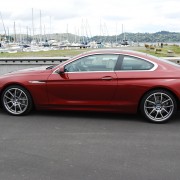
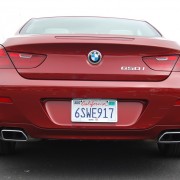
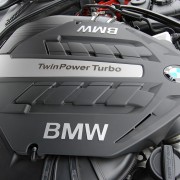
If you need a sportscar and a high performance sedan, look no further than Bimmer’s 650i. Granted, it’s a tad pricey at $101,675. But if you perceive it as 2 cars in 1, you’re on the right reasoning track. If you’re willing to alot $50,000 for each purpose the 650i fulfills, then you’ve saved yourself from buying an extra car. Let’s examine this genteel beast from the sportscar perspective first. Are 400hp and 450 lb.-ft. of torque enough to slake your thirst for V8 twin turbo power? They should be, considering the 650i will turn 107mph in 13.4 seconds through the quarter mile, and post a 0-60mph time of 5.1 seconds on its way to an electronically limited top speed of 150mph. If that isn’t serious sportscar territory, than nothing is.
But what about the handling? In a word, superb. BMW’s Driving Dynamics Control (DDC) system, which is standard on this car, allows you to dial up just the right amount of steering feedback, suspension control, throttle response and traction control permissiveness you need when pushing the performance envelope. An easily accessible button on the standard “Fine Line Oak Wood” center console allows you to bump the default DDC setting from Comfort to Performance or Performance+. If you hold the button down for 10 seconds in the Performance+ setting, you disable Dynamic Stability Control (DSC), putting your enthusiasm and talent in control of the situation. You’ll want to be exceptionally careful in this DSC-deleted Performance+ mode, because many of the safety net override systems are disabled, making it possible to lose control of this heavy and powerful vehicle if you don’t know what you’re doing.
 
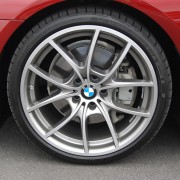
Even though it weighs 4,380 pounds, the 650i feels much more agile than its weight would lead you to believe. That’s because a number of optional systems work in consort seemingly to defy the limits imposed by mass and gravity. Leading the way is Integral Active Steering ($1,750) which really translates into 4-wheel-steering. As you enter a turn, the rear wheels cock slightly in the direction of the turn to augment the adhesion of the huge 20 inch diameter alloys and Dunlop Sport Maxx run-flat DSST tires (245/35/20 front, 275/30/20 rear) which are standard on this model. At 37mph, rear wheel steering turn entry enhancement ends. Further aiding handling agility is the ingenious Active Roll Stabilization ($2,000), which tailors anti-sway bar tension according to need. The faster you drive, the stiffer the sway bars become.
Now let’s examine this coupe’s contribution to family harmony. Although access to the rear seats is by definition limited in any 2-door vehicle, this BMW does its best to make back seat usage feasible and comfortable for all concerned. An oversized latch on the top of the front seats allows back seaters to tilt their way into the plush pair of rear lounge chairs. Even better are the exquisitely crafted front 20-way power Multi-contour chairs, complete with Nappa leather covering and optional ($500) 3-stage heaters. The commodious 16.1 cubic foot trunk, unencumbered by the need to house a spare tire thanks to the run=flat Dunlops, will hold enough baggage to take three adults and their suitcases across country. And what a fine trip it promises to be. On the open highway, the twin turbo V8 settles into a relaxed gate that nets you 23 MPG. Slip the Dynamic Driver Control system into Comfort+ mode, and the 650 metamorphoses from a backroad burner to a freeway cruiser extraordinaire. The optional Bang & Olufsen Premium Sound Package ($3,700) provides an endless array of entertainment options, from 1 year of free Sirius Radio to iPod and USB integration. So if you need a concert hall on wheels with the ride comfort of a ‘60s Cadillac, then give this Bimmer a close look. Because it’s the very same car that will run with a Turbo Porsche on any backroad of your choice.

2012 BMW 650i Coupe
  • Engine: 4.4 liter V8, Direct Injected and Twin Turbocharged
  • Horsepower: 400hp at 5,500rpm
  • Torque: 450lb.-ft. at 1,750rpm
  • Fuel Consumption: 15 MPG City/23 MPG Highway
  • Price as Tested: $101,675
  • Star Rating: 9.5 out of 10 Stars
2012 BMW 650i Coupe2012 BMW 650i Coupe2012 BMW 650i Coupe

2012 BMW 650i Coupe2012 BMW 650i Coupe2012 BMW 650i Coupe2012 BMW 650i Coupe2012 BMW 650i Coupe2012 BMW 650i Coupe

Posted by: D.Colman

Audi A8 Hybrid New 2013

Posted by Blogger Kingdom 0 comments
2013 Audi A8 Hybrid
If silent travel is chief among your priorities for an ecofriendly vehicle, the Audi A8 hybrid is not for you. There isn’t much in the way of quiet, electric-only operation, which makes sense, of course, given that this isn’t a fully electric car. (You can run solely on electrons for about two miles at a constant 37 mph, and if you awaken the engine, EV mode will reengage automatically when you relax on the accelerator. Top speed in all-electric mode is 62 mph.) And although you might never notice its internal-combustion heart beating if you dawdle at or below the pace of traffic, the engine brings attention to itself with a subdued but noticeable growl once you call for any real power.
The sucking, squeezing, banging, and blowing noises come from the VW Group’s ubiquitous 211-hp, 2.0-liter four-cylinder, teamed here with a 54-hp electric motor that’s integrated with a ZF eight-speed automatic transmission. Electrical storage capacity is provided by a 1.3-kWh lithium-ion battery pack. Power is sent only to the front wheels. Combined and at full steam, the powertrain delivers 245 hp and 354 lb-ft of torque. This system is almost identical to the one offered in the A6 and Q5 hybrids.
We Suppose That’ll Do
We estimate the A8 hybrid can reach 60 mph in about 7.2 seconds; Audi claims a drag-limited top speed of 146 mph. It is not governed, and we found you can easily reach 155 or more mph on downhill sections of the German roads on which we drove. This kind of performance should be sufficient for most markets and customers. But it does not compare to the relentless power you feel when you step on the throttle of the 2011–12 BMW ActiveHybrid 7 (since neutered for 2013) or Lexus LS600hL. Nevertheless, piloting this A8 can be satisfying for hybrid lovers who drive without urgency. At that point, this A8’s hybrid system goes about its business unobtrusively. Up to 99 mph, you can do what VW Group brands like to call “sailing,” that is, if you take your foot off the gas, the electric motor doesn’t aggressively recapture energy, allowing for a smoother coasting experience. You’ll be all smiles at the gas station. At 37 mpg in the European combined cycle, the A8 hybrid is the most efficient gasoline-powered luxury sedan. For comparison, on the same test cycle, the Mercedes-Benz S400 hybrid gets 30 mpg, the LS600hL returns 25 mpg, and the 2011–12 ActiveHybrid 7 achieved 25 mpg. (We estimate ratings for the A8 hybrid on the somewhat more realistic EPA cycle at 24 mpg city and 34 highway.)

During spirited driving, you can feel the electric motor lending a hand, a welcome boost during quick passing maneuvers as long as the batteries aren’t depleted, which happens all too quickly. As for when the road begins to bend, it isn’t much fun to test the A8 hybrid’s limits. We love piloting any A8—and we include the sporty S8 here—and it’s our reigning champion in the segment, but this is the least dynamic of the bunch. Even with 290-ish pounds of hybrid gear, at an estimated 4150 pounds, the car isn’t very heavy versus its competition. But with power routed only to the front wheels, this hybrid relentlessly and gracelessly pushes through corners; we wished for Quattro. There is only one other front-drive A8 variant: the Europe-only 204-hp, 3.0-liter V-6 diesel version, which incidentally gets even better combined mileage than the hybrid at 39 mpg on the EU cycle. The brakes are relatively numb, but the transition from electric recuperation to hydraulic braking is well camouflaged.
Other A8s Make More Sense
Otherwise, the A8 hybrid is an exceedingly comfortable long-distance cruiser, and its four-cylinder-based powertrain is sufficient if performance and bragging are not your main objectives. But how much sense does the hybridization make? Its drawbacks include extra weight and complexity, the gas tank shrinks from 23.8 to 19.8 gallons, and trunk space is down from 18 cubic feet to a far-less-usable 11.8.
Audi is bullish about the A8 hybrid's potential in the European market and particularly in China, but it doesn’t believe enough buyers could be found in the U.S. to justify bringing it here. In Europe, it costs less than the 372-hp, 4.2-liter V-8 Quattro but more than the diesel 3.0 TDI with either front-wheel drive or Quattro, as well as the 290-hp version of the gas-fired 3.0T Quattro. All of these, in our opinion, would be more attractive choices, and American A8 buyers looking to scratch an efficiency itch will get by just fine with the 3.0-liter diesel model scheduled to arrive in the next year or so.

July 2012 || BY JENS MEINERS || MULTIPLE PHOTOGRAPHERS

Ford Focus ST 2013 New

Posted by Blogger Kingdom 0 comments

Perhaps the new benchmark in performance compacts.

Once the SVT Focus departed in 2004, we were left staring across the Atlantic wishing for a hot version of Ford’s small car. Now, the Focus ST is here. You can walk into a Ford showroom and plunk down a deposit on 252 horsepower of automotive glee, with deliveries starting later this summer. Consider the Focus ST less of Ford’s answer to the Volkswagen GTI and more of a challenge, throwing down the gauntlet for rights to the sport-compact performance crown.
Fresh and Ready
Our first taste of the Focus ST came at Ford’s Lommel proving grounds in Belgium, where we sampled the tail-happy chassis tuning and electronic wizardry of the torque-steer compensation system from the passenger’s seat. Since then, a few tweaks have been made to the final product. The active sound symposer, a sound tube with a separate throttle body that pipes intake noise straight into the cabin, has been tweaked to offer a deeper tone. On-center steering response has been tightened up in accordance with the ST’s sporting mission, as has the shift lever.
The rest of the details remain unchanged, although the output numbers, now SAE certified, have seen slight upticks. Ford’s turbocharged 2.0-liter EcoBoost four-cylinder sits under the hood, with a unique intake and exhaust. The aforementioned 252 hp comes at 5500 rpm. Maximum torque is 270 lb-ft at 2700 rpm, and an overboost feature helps preserve a nearly flat torque curve by allowing higher turbo pressures for up to 15 seconds at a time. The front brakes are bigger than on a standard Focus, the suspension is lowered 0.4 inch, the springs and dampers are specially tuned, and the rear suspension is revised with a unique mount for the anti-roll bar.
What’s more, as Ford promised, the Focus ST has the same mechanical specification worldwide, right down to the 235/40-18 Goodyear Eagle F1 Asymmetric tires. Which is not to say our Focus ST is outfitted identically to those in every other market—most notably, U.S.-market STs do not come standard with the Recaro seats shown in the model at auto shows. Those come as part of the $2385 ST2 package, which also includes automatic climate control and an 8.0-inch touch screen. For an extra $4435, the ST3 package adds heat and full leather to those seats, plus amenities such as HID headlights, LED daytime running lamps, and navigation.
Consider the Recaros mandatory—they hug your sides slightly tighter, you sit a little deeper than in a regular Focus. As such, you can look at the ST’s base price not as the advertised $24,495 but instead the $26,880 required with the ST2 package included. Even so equipped, the ST matches up favorably in terms of price and features against the Volkswagen GTI and Mazdaspeed 3, as well as Subaru’s WRX and BRZ, Ford’s own V-6 Mustang, and the rest of the crowded sub-$30,000 performance segment.
In the absence of those vehicles for a direct comparison, the Focus ST is, well, pretty amazing. Our drive route took us through southern France, and on both highway and two-lane mountain roads, the Focus appears to fulfill the promise of the affordable daily-driver performance car. When you first sit down in the driver’s seat, you notice the unique interior pieces immediately. A trio of gauges—oil temperature, boost pressure, and oil pressure—sit atop the dashboard. The steering wheel is covered in soft leather with wax paper–like grippiness and thin, high-density foam padding underneath. Less obvious is the stability-control switch in front of the shift lever, absent on lesser Foci, which toggles between full on, sport mode, and fully off.

Willing and Able
The ST proves easy to drive in traffic, with plenty of low-end torque and an easy-to-master clutch and shifter. At higher speeds, the cabin is quiet, as is the exhaust. Drop from sixth to third gear, though, and a smooth engine note fills the cabin—almost a refined blat. The steering—electrically assisted via a rack-mounted motor—is quick at 1.8 turns lock-to-lock. This is partially due to the variable rack, and partially due to the lack of steering angle; the Focus ST’s biggest fault may be its appalling 39.4-foot turning radius. The quick steering feels natural during cornering, and it dials in its substantial heft as well as any electric system.
Hold your right foot down long enough, and the ST will rev past redline to a soft 6800-rpm fuel cutoff. Sweeping up through the rev range is smooth and linear, and feels stronger than the horsepower rating suggests. Ford claims a 0-to-60 time of 6.2 seconds, which seems conservative—we’re thinking something more like six flat. The torque-steer compensation does a decent job, but a tug on the wheel can be provoked with a quick hit of the throttle. Considering all the twist routed through the front wheels, though, we find the system effective.
Equally impressive is the suspension, which handles bumps with a single up-down motion. It’s stiff enough for some head toss when the road undulates heavily, but it’s a worthwhile trade-off for the handling. As we suspected from our preview, this is a car that goes exactly where you point it, all the more remarkable due to its front-wheel-drive layout. And the tail-happy nature is still present, although it’s less prevalent in the dry than during the damp day in Lommel.
Let’s get back to the ST’s main competitors, the GTI and the Mazdaspeed 3. Both have powertrains that essentially date back years to previous generations. That speaks to the essential goodness of both cars, especially in the case of the 10Best-winning VW, but it also gives the impression that neither company is much interested in making significant progress.
The Focus, then, exploits some of that weakness. Where the GTI can be criticized—a softness in suspension and brakes when pushed hard, some lack of power—the ST simply cannot. And where the Mazdaspeed shows its rough edges—wheel-wrestling torque steer and a harsh ride—the ST is smooth. In terms of feel, the Ford splits the gap between these two cars, delivering a good deal of the creamy usability of the VW and much of the balls-out raucousness of the Mazda. An inevitable comparison test will show where the Ford ranks in direct competition, but we can say with certainty that the Focus ST should be on any car enthusiast’s shopping list.
By. BY MICHAEL AUSTIN, June 2012

Mercedes-Benz F800 Style Concept - Auto Shows

Posted by Blogger Kingdom 0 comments
By the time we head to the Geneva auto show in a few days, there won’t be many surprises left to report—which is fine by us, as we’ll be busy arguing with French-speaking cabbies about accepting euros instead of Swiss francs.

Now Mercedes has prematurely announced the F800 Style concept, which seems to be a pretty faithful look at the upcoming 2011 CLS. If accurate, it looks like the next CLS will be as dramatic a departure from the old as the original was from the E-class on which it was based. That’s disappointing to us, as the current car is among the most beautiful cars on the road today, whereas this one—in pictures at least—seems to be based on Zoolander’s “Derelicte” line of nonsense spun as fashion. It looks like they borrowed ideas from a few carmakers and combined them into one, then slapped on an SLS grille and put a BMW 3-series front fascia on the rear. But we’ll reserve final judgment for when we see it in person.

Choose Your Own Alternative-Propulsion Adventure

On the mechanical side of the equation, Mercedes says the F800 could use either fuel-cell or a plug-in hybrid locomotion. Both options are “already close to the series production stage,” according to Prof. Herbert Kohler, “Head of E-Drive & Future Mobility and Chief Environmental Officer at Daimler” and the proud bearer of what is officially the longest title we’ve ever seen on anything. Ever.

The hybrid powertrain couples a direct-injection, 300-hp V-6 gas engine with a 109-hp electric motor that lives in the seven-speed transmission housing and draws its power from a 10-kWh lithium-ion battery stashed under the rear seat. Normally, simply adding the power figures of the internal-combustion engine and electric motor will not accurately produce a hybrid system’s actual power output. But in this case, Mercedes claims just that, stating the F800 has 409 combined horsepower.

The F800’s hybrid powertrain is largely based on that of the upcoming S500 hybrid, which is set to out-thrift its current S400 hybrid once the next-gen S-class arrives. Electric-only range is 18 miles, although speed along closer to the battery-operated limit of 75 mph—higher than what the S500 will allow—will no doubt shorten that leash. The vehicle’s nav system will use the map to show the radius of travel allowed on remaining battery power, although that functionality seems silly given that there’s an internal-combustion engine aboard to propel the car beyond those borders. Mercedes justifies the feature by saying, “should municipalities only permit purely electric automobile traffic in the future, the driver can determine whether the electric range of his or her vehicle is sufficient for the journey into and out of the urban area.” We think that, should municipalities only permit purely electric automobile traffic in the future, we’ll be finding a new municipality in which to reside.

Nevertheless, M-B claims 81 mpg on the Euro fuel-economy cycle. Despite such thrift, the F800 also is said to boast impressive performance. Zero to 60 mph is claimed at just 4.7 seconds, and top speed of course is restricted to the usual German limit of 155 mph.

For the fuel-cell version—we haven’t forgotten about it—the batteries beneath the F800’s rear seat would be displaced by two hydrogen tanks, and two additional tanks would be placed in the transmission tunnel. The motor would be the same one as is in the B-class F-cell, which is available now through a pilot program in California. An electric motor near the rear axle would develop 134 hp and torque in the neighborhood of 210 lb-ft. Not only is this powertrain already found in the F-cell, but Mercedes also has a fleet of city buses operating in Germany propelled by a double dose of this arrangement.

Intelligence Inside

While both the hybrid and fuel-cell drivetrains are imminent, whether we’ll see the technology packed into the F800’s cabin soon is a toss-up. The familiar COMAND system gets a new interface that integrates a touchpad similar to that of the new Audi A8. With Mercedes’ version, the driver uses a fingertip to draw on the touchpad and a camera captures its motion and overlays a ghostly image on the infotainment screen in the center stack. This way, the information display operates as a touch screen without demanding the driver lean forward and without the messy fingerprints. It also recognizes commands similar to those familiarized by the iPhone—tap, wipe, push, turn, and zoom. Additionally, the display in the instrument cluster uses a mirror to make information appear farther away, which will reduce fatigue as the eye switches from near to far focus less often.

Mercedes’ existing safety tech sees an update with the F800, as well. Distronic Plus, the adaptive cruise control, gets Traffic Jam Assistant, which will not only maintain following distance down to and up from a stop, but will now track the vehicle ahead and control steering inputs up to 25 mph.

Pre-Safe, too, gets updated, being promoted to Pre-Safe 360. It will now monitor the area behind the car when stationary in traffic and engage the brakes just before anticipated rear-end collisions, the better to prevent the Mercedes from being pushed into the vehicle ahead. But if the driver sees a window for escape and jumps on the gas, the car will immediately release the brakes.

While we aren’t so excited about the shape of the F800 and hope the expected resultant CLS doesn’t look so much like what you see here, we look forward to seeing the technology featured in the F800 in future Mercedes vehicles.

(BY JARED GALL, PHOTOGRAPHY BY PATRICK M. HOEY AND THE MANUFACTURER)

Mitsubishi Lancer Evolution MR - Long-Term Road Test

Posted by Blogger Kingdom 0 comments
When our long-term Mi­tsubishi Lancer Evolution MR arrived in July 2008, we were hit by a wave of sticker shock. At an as-delivered price of $41,515, the Evo exceeded the starting price of a BMW 335i.

The Mitsubishi comes with a 291-hp turbocharged engine, a six-speed dual-clutch transmission, and one of the most sophisticated all-wheel-drive systems on the market. But a great swath of hard interior plastic and a shortage of amenities such as heated seats made the Evo feel spartan for its price. Not even the touch-screen navigation system, part of the $2550 Technology package (the only option on our car), did much to shake that perception.

For 2010, Mitsubishi has added the MR Touring model that loses the juvenile rear wing and adds some luxury trappings, but it costs $2000 more than the standard MR. The base price on the MR has crept up to $39,735 from the 2008 figure of $38,965.

The Evolution lineup starts at a more reasonable $34,335 in five-speed-manual GSR trim (or $33,710 back in 2008). But we wanted to try the new TC-SST dual-clutch gearbox that is offered only on the MR, which also includes upgrades such as Bilstein shocks, lightweight wheels, HID headlamps, and keyless ignition.

In terms of performance, our Evo did all the right things. Even though it could stand to be more aggressive off the line—Mitsu­bishi says the Evo MR has “launch control,” but labeling the lazy clutch engagement as such is a stretch—the car ripped from 0 to 60 mph in 5.3 seconds when new; at the end of our test, acceleration improved by 0.4 second to 60 and in the quarter-mile. Skidpad grip also increased, from a strong 0.93 g to an astonishing 0.96, and braking from 70 to 0 mph was consistently impressive, at 158 feet when new and 162 feet in our final test. These numbers earn the Evo true sports-car credentials, and its driver-focused environment backs up that impression with big magnesium shift paddles on the steering column and deep, supportive Recaro seats for the front occupants.

The following theme emerged from the logbook: Everything in the Evo comes at a price. Especially at the gas pump. With its SUV-like EPA rating of 17 mpg in the city and 22 on the highway—and a 14.5-gallon fuel tank—we didn’t anticipate bladder-busting range, but the Evo continually surprised us with its need for frequent fill-ups. It only managed more than 300 miles on a tank on three occasions, and highway cruising at 75 mph or above would drop a given tank’s mileage down near our average of 19 mpg.

The second wave of sticker shock came from running costs, starting with the grippy Yokohama Advan A13C tires, which wore out in 16,000 miles and run $351, each. We made the slightly less expensive ($266 per corner) but still great Yokohama Advan Neova AD08 our replacement choice, but we included the price of two sets of OE tires and mounting them in the official tally. Also, it cost $463 to have new rear brake pads installed at 32,700 miles. Regular maintenance further added to the pain of these normal-wear costs, making for a total of $5059. Part of that was a $623 service at 30,000 miles featuring six quarts of transmission fluid at $35 per. The 15,000-mile service ran $228, and lesser maintenance intervals came every 5000 miles and cost between $69 and $150. Compare that $5059 sum—$3128 in tires alone!—with that of our previous long-term Evo VIII, a 2003 model, which rang up $3706 in bills over the 40,000-mile test [April 2005]. Including gas and tires, we paid 28 cents a mile to keep this Evo X on the road.


Pricey operating costs aside, the Evo was essentially trouble-free. We did have to make an unscheduled stop to fix a loose underbody tray. And then there was the rainy night in November 2008, when a Camry rear-ended the Evolution in stop-and-go traffic, sending it to the shop for $5402 worth of insurance-covered repairs.

The six-speed dual-clutch transmission was universally praised for its speedy and crisp gearchanges. We didn’t like the car’s bad habit of taking a second or two to shut down the engine after we killed the ignition; Mi­tsubishi explained that transmission fluid is cycled during this time to preserve the heat-sensitive clutches.

Almost every driver praised the Evo’s sharp reflexes and supreme handling. But as the months wore on, that initial fascination with the car’s terrific performance and technology wore off. Michigan roads, mostly straight and in various states of disrepair, offer little opportunity to take advantage of the Evo’s quick responses. Staffers complained that the ride was too stiff for workaday commuting; most of them had not driven the Evo on a racetrack and were thus short on sympathetic justification. The seats, which some drivers (including this writer) raved about, drew contempt for being too deep for easy exits, too narrow for some hips, and too low (there’s no height adjustment). By the end of our test, the front edge of the driver’s seat showed visible wear.

The trunk, which is compromised by the intrusion of the battery and the washer-fluid reservoir, couldn’t hold two hockey bags when our K.C. Colwell embarked on a weekend rife with busted knees and broken teeth. Out back, the rear wing partly makes up for its view-bisecting location by acting as a push bar for opening the trunklid.

Another driver wrote that he was fonder of the 2003 Evolution because it felt livelier. The Lancer platform on which this latest Evo is based is larger and, in part to meet newer crash standards, results in a roughly 300-pound-heavier car. This newer model offers better overall performance, though the ’03 car was quicker in a straight line. This Evo also has a highly satisfying navigation system and a better interior. (Did we just imply that the old car was a medieval torture chamber? Why, yes, we did.) But these improvements are not enough, we think, to justify the new big price—our long-term ’03 Evo cost just $30,062. Some staffers think this version feels like a fast Lancer whereas the old Evo seemed to transcend its econobox roots and felt more deeply connected to Mitsu’s rallying legacy.

Even at this lofty as-tested price, there are few sedans that can match the performance of the Lancer Evolution. As is often the case, however, numbers aren’t everything. Without a regular opportunity to take advantage of all of the Evo’s capability, the compromises that come with its perform­ance left us wishing for a lower sticker price, more refinement, or both.


Specifications

VEHICLE TYPE: front-engine, 4-wheel-drive, 5-passenger, 4-door sedan

PRICE AS TESTED: $41,515 (base price: $38,965)

ENGINE TYPE: turbocharged and intercooled DOHC 16-valve inline-4, aluminum block and head, port fuel injection

Displacement: 122 cu in, 1998 cc
Power (SAE net): 291 bhp @ 6500 rpm
Torque (SAE net): 300 lb-ft @ 4000 rpm

TRANSMISSION: 6-speed dual-clutch automated manual

DIMENSIONS:
Wheelbase: 104.3 in Length: 177.0 in
Width: 71.3 in Height: 58.3 in
Curb weight: 3659 lb

C/D TEST RESULTS:
Zero to 60 mph: 4.9 sec
Zero to 100 mph: 13.1 sec
Zero to 130 mph: 29.2 sec
Street start, 5–60 mph: 5.8 sec
Standing ¼-mile: 13.5 sec @ 101 mph
Top speed (drag limited): 150 mph
Braking, 70–0 mph: 162 ft
Roadholding, 300-ft-dia skidpad: 0.96 g

FUEL ECONOMY:
EPA city/highway driving: 17/22 mpg
C/D observed: 19 mpg
Unscheduled Oil Additions: 0 qt

WARRANTY:
3 years/36,000 miles bumper to bumper;
5 years/60,000 miles powertrain;
7 years/100,000 miles corrosion protection;
5 years/unlimited miles roadside assistance

(BY MICHAEL AUSTIN, PHOTOGRAPHY BY MARC URBAN)

Jaguar XF Supercharged 2010 - Short Take Road Test

Posted by Blogger Kingdom 0 comments
Just a single model year after the new Jaguar XF hit the streets, considerable powertrain improvements have found their way under its shapely hood. The previous 4.2-liter V-8 has disappeared from all but the base XF Luxury model, while the main mill has grown to 5.0 liters, gaining both horsepower and torque in its supercharged and naturally aspirated applications. Beyond uprating the engines, Jag also added the snarly XFR to the mix, creating a sort of intra-model rivalry and relegating the once top-cat XF Supercharged to middle-child status. How does it stack up now?

Something Old, Something New

A 385-hp, naturally aspirated edition of the 5.0 moves the XF Premium with plenty of verve, while a Roots-type supercharger is added to the same 5.0-liter to create the Supercharged and XFR. Equipped with nearly all the same standard baubles, it’s primarily power that separates the latter two models, to the tune of 470 hp and 424 lb-ft of torque in the Supercharged and 510 hp and 461 lb-ft in the XFR. The XFR, of course, gets all the love because of its added grunt. But examine the performance numbers, and a compelling case emerges for the XF Supercharged.

Same Book, New Chapter

Put your right foot to the floor of the Supercharged, and 60 mph comes in just 4.3 seconds, beating the 2009 XF Supercharged by 0.7 second—and tying our best XFR run. The quarter-mile flies by in an XF Supercharged in 12.7 seconds at 112 mph, just one tenth and 4 mph slower than in the XFR. Coming to a halt from 70 mph is accomplished in 159 feet, not only an excellent number on its own, but also identical to big-brother XFR's. Snowy weather didn’t allow for a skidpad run, but with the same Jaguar Adaptive Dynamics and Active Differential Control systems as found in the XFR, we’re confident the Supercharged could come close to—if not outright match—the best we’ve seen from the burlier car, 0.89 g.

But the numbers merely add to the XF story, they don’t rewrite the book. The sultry exterior and executive-grade cabins of non-R XFs basically are the same as those of the 2009 cars; the Supercharged model now gets quad exhaust finishers. The XF’s sheetmetal continues to command double-takes, and wood and leather are spread around the cabin like butter on a crumpet. The painfully slow infotainment system and pop-up gear selector linger as gripe-getters, however. To avoid repeating ourselves, we won’t rehash the rest of the carry-over goodness. But we will reiterate that the car is athletic and very obedient to inputs, and we still love the stellar ride quality and quick shifts delivered by the six-speed automatic, qualities that helped the XF get named to our 2009 10Best Cars list. (Beyond the stellar crop of cars this year, it’s worth noting that the XF didn’t make a repeat 10Best appearance in part because of some quality issues with our long-term 2009 XF Supercharged.)

If the numbers and the style don’t convince you to give the 2010 XF Supercharged some love, how does $12K in savings over an XFR sound? Starting at $68,000—the only option is a $2200 adaptive cruise-control system that you don’t want anyway—the Supercharged model is the bargain of the bunch, delivering most of the performance and panache of the XFR minus some exterior bits and more heavily bolstered seats. Hell, if you want to save even more money, the naturally aspirated 5.0-liter XF Premium is far from slow. Our advice? Never underestimate a middle child—they may not stand out, but they definitely hold the power to surprise.

Specifications

VEHICLE TYPE: front-engine, rear-wheel-drive, 5-passenger, 4-door sedan

PRICE AS TESTED: $68,000 (base price: $68,000)

ENGINE TYPE: supercharged and intercooled DOHC 32-valve V-8, aluminum block and heads, direct fuel injection

Displacement: 305 cu in, 5000cc

Power (SAE net): 470 bhp @ 6000 rpm

Torque (SAE net): 424 lb-ft @ 2500 rpm

TRANSMISSION: 6-speed automatic with manumatic shifting

DIMENSIONS:

Wheelbase: 114.5 in Length: 195.3 in

Width: 73.9 in Height: 57.5 in

Curb weight: 4481 lb

C/D TEST RESULTS:

Zero to 60 mph: 4.3 sec

Zero to 100 mph: 10.0 sec

Zero to 120 mph: 14.6 sec

Street start, 5–60 mph: 4.9 sec

Standing ¼-mile: 12.7 sec @ 112 mph

Top speed (governor limited, mfr's claim): 155 mph

Braking, 70–0 mph: 159 ft

FUEL (MFR'S EST):

EPA city/highway driving: 15/21 mpg

C/D observed: 15 mpg


(BY JON YANCA, PHOTOGRAPHY BY JORDAN BROWN)

Porsche Cayenne 2011 - Prototype Drive

Posted by Blogger Kingdom 0 comments
Porsche purists may have hated the Cayenne from the moment of its inception, but the success of the truck has allowed the continued production of cars that enthusiasts yearn for. In fact, in one of the supreme ironies of the auto industry recently, the profitability of the VW Touareg–based SUV was a reason that Porsche was able to attempt a hostile takeover of  Volkswagen last year.

Even though that bid failed and Porsche has become part of the VW Group, the new bosses certainly recognize the importance of the Cayenne to Porsche’s bottom line. That’s why we recently found ourselves in the Middle East, evaluating prototypes of the second-gen version of the Cayenne. The vehicle is the product of a revised platform that is shared with the next VW Touareg and Audi Q7. The new Cayenne is 1.8 inches longer overall and rides on a wheelbase stretched 1.6 inches, making for a ­roomier rear seat that now slides fore and aft by 6.3 inches. There are 24 cubic feet of space behind the rear seats, up from 19; with the rear seats folded, the Cayenne will accept 63 cubic feet of stuff, about the same as before.

One of the main criticisms of the previous Cayenne was its blob-like shape, which looked a bit like an eroded brick. For Cayenne No. 2, chief designer Michael Mauer and his team devised more subtle air intakes underneath the front bumper and a more sculpted hood that has cut-lines like the iconic 911’s. The liftgate slopes more now, giving a lighter appearance at the back. While they were at it, the Porsche designers put together an interior that’s similar to the spectacular Panamera’s.

Another point of contention was the porkiness of this Porsche—as much as 5600 pounds in some trims. To get mass under control, the Cayenne now has a heavy dose of aluminum parts: hood, doors, and front fenders, as well as suspension pieces. According to Rolf Frech, director of complete vehicle engineering and quality management, “Trim level for trim level, a new Cayenne is nearly 440 pounds lighter than the old one.” A Cayenne S now weighs 4553 pounds, according to Porsche, some 400 pounds less than the claimed weight of the current Cayenne. However, the last Cayenne S we tested weighed 5351 pounds, which would suggest a still hefty two and a half tons for the new model.

This lower weight is the big reason that the next Cayenne, which goes on sale later this year as a 2011 model, offers better gas mileage than the current vehicle. The current Cayenne already has a range of direct-injection engines, which basically carry over but are updated to the latest-generation, slightly more powerful units from the Panamera. The naturally aspirated 4.8-liter V-8 will make 400 horsepower, a gain of 15, and the Turbo holds at 500. The entry-level 3.6-liter V-6 model will make a less sexy 300 horsepower. A start-stop feature will be standard on all Cayenne gasoline engines.

The hybrid version, which mates a supercharged 333-hp, 3.0-liter Audi V-6 engine with a 52-hp electric motor, most likely will go on sale here in early 2011. This vehicle will, Porsche claims, achieve 29 mpg on the combined European cycle (that’s more like a 25-mpg EPA combined number), which is better than many a mid-size luxury sedan. We’ve driven this powertrain, and it’s remarkably good.

During this first access to the new Cayenne, we focused more on the Turbo (can you blame us?).  As with all the other gasoline engines, power is transmitted via a completely new eight-speed automatic transmission sourced from Aisin that shifts quickly and very smoothly. First and second gears are short, giving fast acceleration off the line. The Turbo has a claimed 0-to-62-mph time of 4.6 seconds. (The S needs 5.9 seconds, and Porsche is traditionally conservative with its performance claims.)

At the other end, the seventh and eighth ratios are long in order to save fuel. Porsche went with a conventional torque-converter automatic because of fears that a dual-clutch gearbox would overheat from the Turbo’s massive 516 pound-feet of torque and wouldn’t be as robust for rock crawling at very low speed. Yes, Porsche still persists with the quaint notion that an SUV ought to be off-road capable (the company does sell a lot of them in the Middle East).

After a couple of hours on what seemed like a never-ending straight road through the Arabian Desert, the quietness of the engine and the lack of tire noise made it difficult to stay awake. Luckily, we left the paved road and turned toward a huge dune area that rose 200 feet and featured very soft and deep sand. Frech and his engineers come here to calibrate the torque distribution of the new Cayenne’s all-wheel-drive system under extreme traction conditions. Under normal road conditions, about 90 percent of the engine’s torque goes to the rear wheels. As soon as the wheel sensors identify a rotational difference between the front and the rear wheels, the system sends more torque to the front—close to 100 percent, if need be.

For off-roading, just move a switch in the center console to the “mountain” symbol. The air suspension automatically raises the Cayenne’s body, and the center differential locks. A rear-diff lock is engaged if the car is fitted with the off-road equipment that’s standard on the Turbo and optional on the others. At full throttle, the Cayenne Turbo jumped to about 50 mph seemingly instantly. In the five seconds after it reached the foot of a dune, the Cayenne dug its tires into the sand and lost some speed but resolutely kept going, with 5000 rpm steady on the tach. At 30 mph, we easily swept to the top of the dune. “You would not do this with its predecessor,” Frech explained. “Only the new Cayenne can apportion the engine’s power over this kind of terrain.”

After plenty of time exploring the Cayenne’s limits in an environment that pretty much none of its American owners will ever encounter—unless they go bounding off into the Mojave on an impulse—we ventured back onto pavement. Corners were hard to find, but we discovered some high-speed bends and dips in the road. The steering is accurate, and stability in fast corners is amazing for a truck.

Although the new Cayenne is still a heavy SUV, the weight reduction and improved electronic chassis systems have made it much more impressive dynamically. It also looks a lot less bulky and ridiculous than it used to. We can’t say that Porsche has coached a lineman into a wide receiver, but this nose tackle now has the mobility of a linebacker.

Ford Edge and Edge Sport 2011 - Auto Shows

Posted by Blogger Kingdom 0 comments
When it was introduced for the 2007 model year, the Edge was like a contemporary Mariah Carey—great to look at, but struggling with a weight problem and the resultant effects on performance. At the Chicago auto show, Ford shows off a freshening that enhances the Edge’s appearance, overhauls the interior, and, although not directly addressing the issue of mass, will increase performance.

Like most mid-cycle refreshes, the Edge’s 2011 update starts with a nose job. Every panel up front is new: hood, fenders, grille, and fascia. The result is a sultrier shape than the blocky original Edge—the headlights are narrower, the three-bar grille dips deeper into the fascia, and the overall look is softened and rounded—but still clearly descendant from it. Around back, the hatch is new, with taillights that ditch the trendy clear lenses of the original model for more timeless red ones.

Functional Changes

Underneath that new hood, the Edge will have a selection of two new engines and one updated unit. The new base engine will be a 2.0-liter turbocharged, direct-injected EcoBoost four-cylinder. Power figures have not been released yet, but figure on about 230 hp and 240 lb-ft of torque. Mid-level SEL models will get the 3.5-liter V-6 from the previous Edge, but updated with variable timing on both intake and exhaust camshafts, with output increasing 20 hp and 3 lb-ft, to 285 and 253, respectively.

Top-of-the-line Sport models, in addition to unique black grille slats, smoked head- and taillights, and black-trimmed, 22-inch wheels; get Ford’s 3.7-liter V-6, which delivers a relatively modest bump in hp—to 305—over the 3.5, but a torque gain of 27 lb-ft, for a total of 280. All three engines will be paired with six-speed automatics, with the Sport featuring standard paddle shifters that are unavailable with the other engines.

It’s What’s Inside That Counts

The Edge’s new interior is perhaps even more attractive than the sheetmetal. A sleek new center stack steals the show, housing Ford’s new MyFord and MyFord Touch vehicle-interface systems. These two are the next evolution of Ford’s Sync. MyFord will be standard on all 2011 Edges, but MyFord Touch costs extra. Both are vehicle-management systems using a small LCD screen in the gauge cluster—the fancier MyFord Touch gets two, one on either side of the speedometer—and a larger LCD screen in the center stack.

The small screens in the IP are controlled by five-way switches (up, down, left, and right arrows plus a center “select” button) on the steering-wheel spokes, while the center is operated via touch. The left IP screen is the only one MyFord buyers get, and it displays vehicle information such as stability-control settings, a tachometer, or trip-computer information. The screen to the right of the speedometer—again, only available with MyFord Touch—is reserved for audio, phone, navigation, and climate-control info. The center screen handles the same information as the right smaller screen, with the added benefit of being accessible to the front passenger.

Call it the Kitchen Sync

All of MyFord and MyFord Touch’s functionality builds on top of the next-generation Sync features, which include easier interaction through what Ford calls “direct speech” commands. No longer does a person dial a phone number by saying “phone” then waiting for Sync to respond before saying “call Jane.” Now, the command is simply “call Jane,” and Sync makes the call. Or, if you want to find a sporting event, you can simply say “tune to Baltimore Ravens game” rather than flipping through channels looking for the game, and Sync will find it. For a full rundown of all the details, read our coverage of the two systems from the Consumer Electronics Show.

Additionally, below the MyFord interface are capacitive-touch controls for audio and climate, and those opting for the upgraded Sony stereo are treated to a Sony-designed audio interface. Though the system does look cool, we see frustrations growing from audio controls that will not react to thickly gloved fingers.

A vehicle with features like MyFord Touch can’t get by without a healthy dose of technology elsewhere. To that end, the Edge also will receive a bunch of optional high-tech gear including keyless entry and ignition, blind-spot monitors, adaptive cruise control, and rain-sensing windshield wipers. The 2011 Edge will go on sale later in 2010. Pricing should remain close to today’s levels, with a base SE beginning around $28,000 and Sport models starting near $35,000.

(BY JARED GALL, PHOTOGRAPHY BY LEVI HILLGER AND THE MANUFACTURER)

Porsche 911 GT3 R Hybrid - Auto Shows

Posted by Blogger Kingdom 0 comments
Porsche’s plans for hybrid road vehicles are nothing new—the company plans to introduce a hybrid Cayenne SUV in the truck’s next generation, as well as a hybrid version of its Panamera sedan—but at the Geneva auto show, the German sports-car king will introduce a hybrid race car based on its 911 GT3 R. It’s no mere concept, either. Following its debut, the car will head to the Nürburgring, where it will compete in the 24-hour race on May 15 and 16.

This hybrid is unlike anything you’ve previously heard called a hybrid. Rather than the bulky battery pack associated with roadgoing hybrids, Porsche’s racing hybrid system utilizes an electrical flywheel generator to capture and store kinetic energy. Sitting where the passenger would be in a road car, the flywheel generator is charged by a pair of 60-kW motors in the front wheels and stores its energy mechanically as it spins up to 40,000 rpm. When fully charged, the generator can send bursts of 161 hp back to the front-wheel motors for periods of up to six to eight seconds. The rear wheels have full-time, exclusive access to the naturally aspirated flat-six's 480 hp.

This system is essentially the KERS (Kinetic Energy Recovery System) technology that generated so much controversy in Formula 1 racing last year—it is similar, but not, as is being widely reported, the same as that developed by the Williams F1 team. Porsche’s system was developed in conjunction with Williams, but considering that the shroud of secrecy in F1 would seem impenetrable to even Dan Brown, the exact differences are hard to come by. We’ll see if we can’t shake loose a little more information as the car’s debut in Geneva nears.

(BY JARED GALL)

Lightweight Audi A5 2.0T Concept - Prototype Drive

Posted by Blogger Kingdom 0 comments
Taking weight out of a modern car can be tricky: Crash regulations have necessitated heavier structures, emissions laws have forced additional complexity into vehicles, and amenities have added dozens of electronic control units and untold miles of cable. Many automakers, however, are now experimenting with shedding pounds as a means to maintain performance despite the current trend toward engine downsizing. To illustrate the potential of this approach, Audi engineers set out to create an A5 2.0T that weighs 500 pounds less than a 3400-pound Euro-spec A5 V-6 model (U.S. versions weigh roughly 200 to 300 pounds more due to options and higher levels of standard equipment). The result is an A5 coupe that, according to Audi, tips the scales at a svelte 2888 pounds despite retaining the 2.0-liter’s heavy iron block.

Audi let us compare a stock A5 3.2 FSI, equipped with the 265-hp V-6, against the lightweight concept with the 2.0-liter engine dialed back from 258 pound-feet of torque to deliver the same 243 as the V-6. We can attest to the fact that a 500-plus-pound reduction makes for a stunning dynamic improvement. Turn-in becomes more agile, the car can be tossed around with ease, and the 211-hp engine feels far stronger than its numbers suggest.

A regular A5 3.2 FSI seems downright clumsy in comparison. Audi claims the lightweight concept is 0.3 second quicker to 60 mph than the V-6. In our testing, the A5 V-6 ran from zero to 60 mph in 5.8 seconds, so we expect the lightweight concept to hit 60 mph in 5.5 seconds, a 0.7-second improvement over a standard A5 2.0T.

Audi originally intended the concept to emulate the performance of the V-8–powered, 354-hp S5, but, despite the weight loss, the concept still can’t match the S5’s acceleration. We understand that a second concept is currently being built—and we wouldn’t be surprised if this one was equipped with the 265-hp, 2.0-liter turbo four from the TTS. With that much power, the four-cylinder lightweight just might be able to trounce the S5’s V-8.

Most “efficiency” concepts make us dread the future; this one gives us hope.


(BY JENS MEINERS, PHOTOGRAPHY BY MATTHIAS KNÖDLER AND THE MANUFACTURER, ILLUSTRATION BY BRYAN CHRISTIE DESIGN)

BMW 335is Coupe 2011 - First Drive Review

Posted by Blogger Kingdom 0 comments
To fill the gap in the 3-series lineup between the 300-hp 335i and 414-hp M3, BMW is introducing the 2011 335is coupe and convertible. We were unaware that said gap needed to be filled, but we’re told that the 335i is seen in the U.S. as just an ordinary 3-series, and as such, there’s room for something more exotic than a 335i but less outlandish than an M3. Now that we’ve been given the chance to drive the 335is coupe, we’re coming around to accepting this whole gap idea.

More Power and a Body Kit and . . .

Conceptually similar to the 330i Performance package model that was available as part of the previous-generation 3-series lineup, the 335is doesn’t go so far as to threaten the M3’s supremacy, but it definitely ups the sportiness quotient. To that end, the 335is gets 320 hp and 332 lb-ft torque from the twin-turbo 3.0-liter inline-six engine, and an overboost function allows for seven-second blasts of 370 lb-ft of torque. Unlike the regular-grade 2011 335i, the 335is sticks with the older twin-turbo engine for the simple reason that BMW engineers had more experience tuning it. This same engine can also be found in the Z4 sDrive35is that was introduced at this month’s Detroit auto show. In the Z4, the engine makes 335 hp; a more restrictive intake on the 3-series accounts for the 15-hp difference.

To make the 335is a track-worthy vehicle, BMW upgrades the cooling system with an additional radiator and beefs up the engine mounts. Inside are standard sport seats, steel pedals, an M Sport steering wheel, and textured aluminum trim. Between the seats sits the familiar six-speed manual, but it’s modified here to have shorter throws. For those who prefer not to shift for themselves, BMW is offering its seven-speed dual-clutch gearbox. The DCT system is identical to the one in the M3 and comes with steering-wheel-mounted paddle-type shifters.

Exterior styling builds on that of the 3-series’ 2011 freshening and adds an aggressive M Sport body kit. The kit has a more aggressive front fascia that ditches the coupe’s fog lamps in the interest of increased cooling capacity; the 335is convertible keeps its fog lamps. (And just to confuse you, we posted photos of preproduction coupes with fog lights; the decision to ditch them apparently came after these cars were built.) A new rear bumper incorporates a diffuser-style piece, and the twin exhaust pipes are finished in matte black. New gray-painted, split-five-spoke wheels are the only change to the chassis, despite the extra power—there are no tweaks or modifications to the suspension or brakes.

Same Poise, Even Better Soundtrack

Immediately on starting the engine, one detects a more noticeable hum from the new exhaust system. Less-restrictive mufflers snarl menacingly and only get angrier once the throttle is matted and the revs rise. As we’ve seen with other applications of the twin-turbo six, power is delivered with the immediacy of a large-displacement, naturally aspirated engine. The extra horsepower bestowed on the 335is isn’t exactly massive, but the car will still quickly shrink a straightaway, and it rockets into triple-digit speeds as if towed by a Boeing 747. Indeed, a few laps around Portugal’s Estoril racetrack revealed this car to be exactly what’s suggested by the spec sheet: a powerful 3-series with a fantastic soundtrack. As one might expect from the carry-over chassis, the balance, the predictability, and the unflappable poise that make the 3-series one of our favorite cars are all there in spades.

The 335is doesn’t exactly threaten the M3 performance-wise, and with a starting price of $50,525, the 335is coupe costs $8750 less than an M3 coupe. But compared with the M3 sedan, the 335is coupe saves only $5750; faced with that choice, we’d pony up for the four-door M3. Convertible versions of the 335is start at $59,075, or $8850 less than the M3 convertible. The 335is convertible will arrive in April; coupe buyers will have to wait until June. And don’t go looking for the 335is at dealerships outside North America; for once, BMW is building something just for us.


Specifications

TRANSMISSIONS: 6-speed manual, 7-speed dual-clutch automated manual

DIMENSIONS:
Wheelbase: 108.7 in Length: 181.9 in
Width: 70.2 in Height: 54.1 in
Curb weight: 3650–3750 lb

PERFORMANCE (C/D EST):
Zero to 60 mph: 4.5–4.8 sec
Standing ¼-mile: 13.2–13.5 sec
Top speed (governor limited): 155 mph

FUEL ECONOMY (MFR'S EST):
EPA city/highway driving: 17/26 mpg

(BY TONY QUIROGA )

Mazda RX-8 R3 2009 - Short Take Road Test

Posted by Blogger Kingdom 0 comments

New sports coupes arrive like summer lightning and depart like uneaten guacamole: ignored, slowly fading to brown, awaiting the inevitable flush. The six-year-old Mazda RX-8 languishes through 2008 with sales the Hubble telescope wouldn’t register: just 2591 units through the end of August.

Mazda isn’t giving up, however. The Hiroshima headquarters considers rotary engines integral to its identity, so the RX-8 stays, a place keeper for a future all-new rotary engine currently code-named “16X” and due perhaps by 2012.

Meanwhile, the RX-8 gets a little stir to keep it green. Most obvious is the new front bumper that flares the grille and brake-duct openings for a more dangerous, grinning-cobra menace. Four glassy robot eyes now fill the taillight teardrops, the exhaust tips are bigger, and fresh wheel designs adorn the various trim levels.

Underneath, Mazda adds chassis stiffeners to further tighten an already athletic platform, and tweaked rear-suspension geometry settles the back end and helps sharpen steering response. The prop shaft also has been strengthened to reduce driveline vibration and noise.

Also new for ’09 is the R3. At $32,600, the RX-8 R3 is priced just $930 above the luxury Grand Touring and trades a few of the GT’s comfort bits—heated mirrors, automatic climate control, power seats—for go-fast bits such as 19-inch forged aluminum wheels, Bilstein shocks, and Recaro-brand leather-trimmed buckets. A spoiler, side-sill extensions, fog lights, and an even angrier front bumper also ride along, as does a 300-watt Bose stereo.

Steering that answers to palm twitches remains the RX-8’s best selling point, the R3 cruising flat and neutral through the wiggles without tire squeal or shimmy. Call us surprised that our skidpad runs were lower, generating 0.87 g to our previous 0.92. Brake performance stays about even, and the R3 impresses as every bit the joy toy its predecessors were.

The six-speed-only R3 runs on the same 232 horsepower and 159 pound-feet of torque as other RX-8 manuals (autos have 212 horses) but has foam-filled front crossmembers linking the front-suspension pickups for better sound-and-vibration damping. At 3060 pounds, the R3’s curb weight exactly matches that of our last RX-8 test car [“Four of a Kind,” June 2007].

The low-torque RX-8 was always tricky to get rolling without a stall. A shorter rear-end ratio in all 2009s—4.78:1 versus 4.44—means less revving and clutch slip in everyday driving. However, the second-to-third shift is now perilously close to 60 mph, which likely slowed the acceleration runs (6.7 seconds to 60 mph versus 6.5). Fuel economy isn’t helped or, apparently, hurt. We averaged 15 mpg, same as before.

Sporty cars come and eventually go, but for now, Mazda’s entertaining eccentric is signing up for another rotation.

VEHICLE TYPE: front-engine, rear-wheel-drive, 4-passenger, 2+2-door coupe

PRICE AS TESTED: $32,600 (base price: $32,600)

ENGINE TYPE: 2-rotor Wankel, aluminum rotor housings with iron liners and end plates, port fuel injection
Displacement: 80 cu in, 1308cc
Power (SAE net): 232 bhp @ 8500 rpm
Torque (SAE net): 159 lb-ft @ 5500 rpm

TRANSMISSION: 6-speed manual

DIMENSIONS:
Wheelbase: 106.4 in Length: 175.6 in Width: 69.7 in Height: 52.8 in
Curb weight: 3060 lb

C/D TEST RESULTS:
Zero to 60 mph: 6.7 sec
Zero to 100 mph: 17.7 sec
Zero to 130 mph: 40.3 sec
Street start, 5–60 mph: 7.7 sec
Standing ¼-mile: 15.1 sec @ 93 mph
Top speed (drag limited): 141 mph
Braking, 70–0 mph: 152 ft
Roadholding, 300-ft-dia skidpad: 0.87 g

FUEL ECONOMY:
EPA city/highway driving: 16/22 mpg
C/D observed: 15 mpg

(BY AARON ROBINSON, PHOTOGRAPHY BY MORGAN SEGAL)

Mazda Five 2011

Posted by Blogger Kingdom 0 comments
The bulk of the Mazda lineup has recently been updated, and the Japanese carmaker will bring its Mazda 5 small minivan in line when it unveils the new 2011 model at the Geneva auto show in early March.

The update represents the model’s first major freshening in a while, and the first since going on sale in the U.S. in 2005. The 5, which is known as the Premacy in Japan, takes on styling cues from the Mazda 3 on which it’s based, in particular the smiley-face grille and pronounced fenders. Moving aft of the A-pillars, Mazda says the new 5 is the first production model to fully adopt the wind-blown, swooping styling language the company has refined on several stunning concepts, starting with the Nagare in 2006 and including the Furai racer from 2008.

Inspired by the beauty of flowing elements in nature—nagare means “flow” in Japanese—the design language is most evident along the sides of the 5, where swooping creases between the beltline and rockers appear to be sculpted by the wind, lending a sense of motion. These particular elements can be found in all the previous concept vehicles and, according to Mazda, help the 5 achieve improved aerodynamic efficiency with less drag and more optimal lift characteristics. The result definitely is striking—think BMW’s flame surfacing on magic mushrooms. A more-sculpted rear fascia with revised taillights rounds out the major tweaks to the body.

We have yet to learn the extent of the interior changes, but the layout will remain a spacious and flexible place for six, complete with dual sliding doors for easy entry and exit. Improved materials and revised equipment are expected in order to keep the 5 on par with the updated-for-2010 CX-7 and CX-9.

The 2011 Mazda 5 will go on sale in Europe in the fall of this year with several powertrains, the most notable of which is a new, direct-injected 2.0-liter inline-four with the company’s “i-stop” stop/start technology. When equipped with a six-speed manual transmission, the new 5 is said to reduce carbon-dioxide emissions, which are directly tied to fuel consumption, by 15 percent. A 1.8-liter four and a small-displacement turbo-diesel also will be available.

The current U.S.-market 5 sports a 153-hp, 2.3-liter four mated to either a five-speed manual or five-speed automatic gearbox. While we don’t expect performance to match that of, say, our Mazdaspeed 5 Boss Wagon, the fitment of the redesigned-for-2009 Mazda 3’s optional 2.5-liter mill, which makes 167 hp and is paired with either a six-speed manual or a five-speed auto, seems likely. As is par for the course these days, expect a slight bump in fuel economy over the current car’s city/highway ratings of 22/28 mpg with the manual and 21/27 with the automatic.

(BY MIKE SUTTON)

Ford Edge Sport 2011 - Spied

Posted by Blogger Kingdom 0 comments
The big reveal of the refreshed 2011 Ford Edge will take place in about two weeks at the 2010 Chicago auto show, but why wait—these spy snaps give us a pretty clear idea of what form it will take. Not only that, but this prototype also previews the Sport trim, which should continue to be the sharpest-looking Edge in the drawer.

As with its twin, the Lincoln MKX, the angular Edge undergoes a dramatic mid-cycle revamp for 2011, starting with fresh front-end styling that actually has some radius edges. Indeed, shades of the Toyota Venza and the Honda Accord Crosstour—both prime competitors—can be seen in the Edge’s visage, with a vast majority of its frontal area devoted to the T-shaped arrangement of the headlamps and thick three-bar grille. It does not appear, however, that the new fascia will be affixed to new front fenders (the MKX, by comparison, is all-new from the A-pillars forward), but certainty on that point is complicated by this prototype’s black-and-white “cheese-puff” camouflage.

Other aesthetic changes for the standard Edge are expected to be minimal, although this Sport prototype wears flashier rocker panels and a diffuser-look rear bumper as conspicuous conceits to its Sport designation. And speaking of conspicuous, the 22-inch wheels seen here are kinda, sorta bitchin’, especially for a stock-out-of-the-box Ford family car. Rounding out the appearance changes are the new taillamps, which will feature LED elements.

Count On a Vastly Improved Interior

What we can’t see here is the new tech-laden cabin, although Ford itself released images of the interior a few weeks ago when it announced an innovative new connectivity suite called MyFord and MyFord Touch. (The systems include things such as in-car WiFi, improved Sync voice control, apps, and iTunes audio tagging; it all sounds pretty cool.) As such, we already know that the interior of the 2011 Edge will feature upgraded materials and capacitive touch controls in place of some conventional buttons and switches.

While the Edge and Edge Sport currently share one engine—a 265-hp, 3.5-liter V-6—the 2011 Edge could follow the MKX in offering FoMoCo’s 305-hp, 3.7-liter V-6, possibly as an upgrade exclusive to the Sport model. Of course, switching the entire lineup to the 3.7-liter mill is entirely possible, too. However the V-6 situation pans out, it’s relatively certain that the Edge will eventually be available with an EcoBoost turbocharged engine. It’s more likely to be the highly anticipated new 2.0-liter turbo four-cylinder rather than something burlier like the 355-hp, twin-turbo V-6 seen in the Taurus SHO and Flex EcoBoost. Ford has said that the 2.0-liter will be good for at least 230 hp.

Look for the 2011 Ford Edge to appear in showrooms late this summer. Of course, if you’re willing to brave some brutal cold and head to the 2010 Chicago auto show next month, you can see it long before then. Even better: Stay warm and point your browser right back here in just a couple of weeks to read full product information and see our photos from the show floor.

(BY STEVE SILER, PHOTOGRAPHY BY BRIAN WILLIAMS FOR BRENDA PRIDDY & CO. AND THE MANUFACTURER)

Lincoln MKS With EcoBoost 2010 - First Out of the Gate

Posted by Blogger Kingdom 0 comments
The arrival of the MKS sedan last year spurred hopes that it might revitalize Ford’s historically uncompetitive luxury brand, helping Lincoln to better compete with Cadillac, Lexus, and other aspirational marques. Most of the hype stemmed from the stunning MKR concept that debuted at the 2007 Detroit auto show; it floated the idea that future Lincolns wouldn’t be dowdy, livery-service specials like the current Town Car.

As it turns out, the MKS is indeed light-years beyond that ancient Panther-platformed barge in both styling and performance. But the production 2009 MKS came to market lacking the MKR’s exaggerated proportions, rear-wheel-drive chassis, and twin-turbocharged V-6—which then carried the aggressive TwinForce moniker. The reality of the MKS’s front-wheel-drive foundation (shared with the Ford Taurus) and naturally aspirated, 3.7-liter V-6 making 275 hp and 276 lb-ft of torque put it at a disadvantage with more powerful luxury sedans.

But Ford is now upping the big Lincoln’s game, as it will finally be available with a twin-turbo, 3.5-liter V-6 when the 2010 model arrives in showrooms in mid-summer. Although the engine carries the more marketing-friendly EcoBoost name, its 355 hp and 350 lb-ft of torque are for real and give the Lincoln the gusto to run with most V-8s. We recently had the chance to sample the new turbocharged model—as well as the 2010 MKT crossover—at Ford’s Michigan proving ground, where the company had a V-8 Cadillac STS and Infiniti M45x on hand for comparison.

Movin’ On Up

Supported by standard all-wheel drive and a beefier six-speed automatic transmission with paddle shifters and revised gear ratios, the EcoBoost MKS proved to be a far more compelling vehicle to pilot than the base car. However, it should be noted that, although the Lincoln handily outpaced the Cadillac and Infiniti in acceleration, technology, and refinement, Ford conveniently chose two of the oldest and least powerful vehicles in the segment for comparison.

With peak torque available as low as 1500 rpm, the direct-injected EcoBoost V-6 is flexible in its power delivery and motivates the near-4500-pound MKS with uncanny ease. Compared with the non-EcoBoost MKS—which takes 7.5 seconds to reach 60 mph and covers the quarter-mile in 15.7 at 90 mph—the twin-turbo car is a rocket. Away from Ford's proving grounds and on our test track, acceleration was smooth and linear up to the 134-mph top speed, with 60 arriving in 5.4 seconds and the quarter in 14.1 at 100 mph. Turbo lag is nonexistent and the exhaust note is hushed but noticeable, with a subdued growl that never gives the impression the engine is being worked too hard.

Although the prodigious low-end grunt tops that of many V-8s, Ford says the EcoBoost engine’s direct injection, compact turbochargers, and smaller displacement allow it to sip fuel like a proper V-6. Our short stint behind the wheel, with the throttle frequently contacting the floorboard, didn’t give us much of an idea about real-world economy. Still, the EcoBoost MKS’s city/highway mileage of 17/25 mpg beats the EPA figures for the STS and M45x—again, conveniently—which are rated at 15/22 and 14/20, respectively. The front-wheel-drive, 3.7-liter MKS is rated the same as the EcoBoost model; the all-wheel-drive base car gets 16/23 mpg. However, the Lexus GS460 with its 342-hp, 4.6-liter V-8 matches the economy of the boosted MKS, and the more powerful—and less expensive—Hyundai Genesis V-8 manages 1 mpg better on the highway. Although the Lincoln’s ratings are surely influenced by its porky curb weight and have yet to be verified by the EPA, we think it might have been better had Ford kept the cooler-sounding TwinForce name if the primary benefit of EcoBoost is performance.

Improving the Package

Along with the new engine option, all 2010 MKSs get revised suspension tuning for more confident handling and additional sound deadening to curb road noise. The 2009 model was by no means loud inside, but the revisions make the 2010 car truly serene, even at triple-digit speeds. Opt for the EcoBoost model, and the chassis gets electric power steering, stiffer anti-roll bars and front subframe mounts, and new shocks, springs, bushings, and upper shock mounts. The result is more responsive footwork with light yet communicative steering. Ford’s ride-and-handling loop showed the MKS to be well controlled and borderline playful when driven in anger, although the rear end has a tendency to feel a little light when the car is pushed hard. The changes don’t make the MKS ideal for assaulting sinewy canyon roads, but it does drive smaller than it is. Around the skidpad, the MKS managed to hang on at 0.83 g, while braking from 70 to 0 mph occured in 175 feet, with considerable fade after a few attempts.

Also available later this year on EcoBoost models is an appearance package ($2995) that includes unique 20-inch chrome wheels (18-inchers are standard); black-accented headlights and taillights; a revised front fascia; a small, chrome-accented trunk spoiler; and unique MKS badging with the S in red. The splurging carries over to the inside as well, with Sienna leather upholstery and trim, a metallic dash appliqué with MKS badges, and special illuminated door sills and floor mats. As with every MKS we’ve driven, the cabin is comfortable, spacious, and well designed. The front seats are heated and cooled, and they’re supportive without being constricting. Rearward vision could be better, though, and the back seat isn’t exactly commodious. The gauges and the center-stack controls are attractive and easy to use, as is the infotainment system, complete with an eight-inch touch screen and optional THX II 5.1 premium sound system.

Although many of the technologies on the MKS carry over from last year, new for 2010 is active park assist, which employs ultrasonic distance sensors and electric power steering to find and guide the vehicle into a suitable parallel parking space. Press the button on the center console and drive past a potential parking space, and the system will tell you if the car will fit. If the spot proves big enough, slide the gear lever to reverse and work the gas pedal while the computer manages the steering and watches how close you are to other vehicles. The whole operation takes about 20 seconds, with training yourself to trust the car and let go of the steering wheel the biggest challenge. Active park assist costs $535 on the MKS and will be available on several other 2010 Ford vehicles.

First Out of the Gate

Starting at $48,585, the 2010 MKS with EcoBoost comes well equipped, with standard features including keyless access with a keypad and push-button start, adaptive HID headlights with auto high-beam control, rain-sensing wipers, ultrasonic parking assist, and Sync with Bluetooth. A front-wheel-drive, non-EcoBoost MKS is about $1200 more than the 2009 version, at $41,695, with all-wheel drive adding another $1890 to the tally. Option bundles, ranging from $2500 to $4500, are available for base and EcoBoost models and add stuff like 19- or 20-inch wheels, navigation, the THX sound-system upgrade, and a rearview camera, depending on the model. Adaptive cruise control with brake support ($1310), a dual-panel sunroof ($1695), and various paints and wood trims are stand-alone options.

Although the MKS will be the first Ford to go on sale with an EcoBoost engine, it won’t be the only one. The automaker plans to offer four- and/or six-cylinder EcoBoost powerplants in 90 percent of its models by 2013. The MKT crossover will join the EcoBoost roster when it goes on sale in late summer, and the Ford Flex and Taurus SHO will offer the 3.5-liter engine for 2010. Although the additional power of the new engine doesn’t transform the MKS into a sports sedan, it does make it much more competitive and gives the brand a better chance at reestablishing itself. We’ll have to wait to see how well the new MKS does in the real world—and if the updates justify the loaded-up price of $56,000—but we can definitely say this isn’t your typical Lincoln.

Lamborghini Gallardo 2010

Posted by Blogger Kingdom 0 comments

Vehicle Highlights

The 2010 Lamborghini Gallardo (guy-YARD-oh) should not see many major changes. This all-wheel-drive exotic should remain the Italian company's entry-level car. The car should come in LP560-4 hardtop and LP560-4 Spyder convertible versions. The Spyder convertible has a power-folding soft top. Lamborghini's Ad Personam program, new last year, should remain available. This program allows personalization of the car with new paint finishes and interior materials. All Gallardos should remain all-wheel drive and use the LP560-4's direct-injection 560-hp 5.2-liter V10. Transmission choices should include the 6-speed manual and 6-speed automatic that includes steering-wheel paddles for manual gear selection. Most structural and body components should continue to be made of aluminum or lightweight carbon fiber. Available safety features should be unchanged, including ABS, traction control, antiskid system, and side airbags that cover the head and torso. Other available features should include a navigation system with TV reception, rearview camera, wireless cell phone link, and carbon-ceramic brakes. We have not yet tested an LP560-4.

ROAD TEST
Our road test for the 2010 Lamborghini Gallardo includes a full evaluation of the 2010 Lamborghini Gallardo from the inside out. We evaluate not only engine and handling performance for the 2010 Lamborghini Gallardo, but also interior cabin and cargo space. Let our comprehensive road test ratings for the 2010 Lamborghini Gallardo help you decide if a 2010 Lamborghini Gallardo is right for you.

SAFETYSpecs and safety for the 2010 Lamborghini Gallardo include detailed information on everything from fuel mileage to seating capacity. NHTSA crash-test scores for the 2010 Lamborghini Gallardo are provided as well as manufacturer warranty information.