Showing posts with label Audi. Show all posts

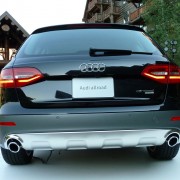
Audi allroad Review 2013

Posted by Blogger Kingdom 0 comments


By Judy Colman

The hills around Denver, Colorado were alive with music, but not with the voices of the von Trapp family. This music emanates from the humming engines of Audi’s eighth version of their ‘B’ Segment lineup – the Audi A4, S4, A5, S5 and, again, the Audi allroad.
For 2013, Audi reintroduces the allroad, last available in the US in 2005. This new version replaces the A4 Avant in Audi’s model line. Now based on the A4 platform rather than the A6, the new allroad is faster and more energy efficient than its predecessor. A 211 horsepower, 2.0-liter, direct-injection I4, turbocharged engine provides plenty of oomph to tackle the Rockies while still delivering 23 (combined) mpg. 258 lb.-ft. of torque are generated at 1500 rpm. Audi links the 2.0T motor with an eight –speed Tiptronic automatic transmission. A manual transmission is not currently available. We tested quattro, Audi’s permanent all-wheel drive system, when afternoon thunderstorms all but obliterated the roadway. Grip on the slick, mountain curves never wavered on the standard 18-inch wheels shod with 245/45 all season tires.
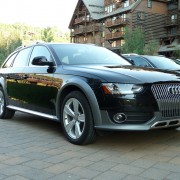
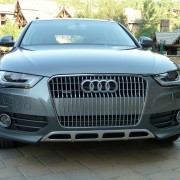
The 2013 allroad receives the distinctive Audi “Singleframe” grille with vertical chrome struts and angled upper corners. That feature appears also on all ‘B’ Segment cars for a homogeneous look. Newly designed headlamps, fog lamps, side mirrors, taillights, and exhaust add to the fresh appearance. The new allroad’s longer wheelbase adds ride comfort and an additional 1.5 inches of ground clearance. That and a widened track makes off road trekking a little easier. Body cladding, traditionally a matte finished gray/black is also available in full paint finish.

Technology abounds in the 2013 allroad. If you are travelling at less than 19 mph, the Audi Adaptive Cruise Control system can fully stop the car if it senses a collision. An electromechanical power steering system, Audi Dynamic Steering, replaces a traditional hydraulic system. It requires no additional energy from the engine, if it is travelling in a straight line, and thereby reduces emissions. Factory installed wireless internet, called Audi Connect, a 3G online connection, is now available on the allroad as well as all ‘B’ Segment models. Paired with Audi’s MMI Navigation, Google Earth maps will be joined in 2013 with Google’s street view technology. While you’re busy looking at the mountain scenery, your tech-obsessed passengers can take full advantage of their electronic toys. Your allroad is now a Wi-Fi hotspot capable of connecting up to 8 devices. Who said the hills aren’t alive with music, and games, and movies, and texting?
Despite the fact that the 2013 allroad is now based on the smaller A4 platform, overall height increases by 2.3 inches offering more front passenger headroom than in previous models. Driver seat memory, heated front seats, a panorama sunroof, and an available sports interior package welcome passengers. The revised instrument cluster looks modern and crisp. Fold down the 40/60 split rear seat and load the 50.5 cu. ft. of cargo space with everything you need for your mountain adventure. Interior design is sophisticated and refined. Standard leather seating alone puts allroad ahead of its rivals, notably the BMX 328i xDrive and the larger Volvo XC70.

Three trim levels of the 2013 allroad are available: the Premium starting at $39,600, the Premium Plus starting at $42,900, and the Prestige model at $48,800.
Because the 2013 allroad has few competitors in the market, Audi is betting the American public is again ready for this revised version. As an alternative to the crossover or small SUV, the Audi should appeal to anyone needing a little extra space without compromising handling and comfort. The hills may not be alive with “Do-Re-Mi” but maybe with a little Zac Brown Band, or Black-Eyed Peas, or the sweet sound of a 2.0T motor humming up a mountain pass.
Audi A8 Hybrid New 2013

Posted by Blogger Kingdom 0 comments
2013 Audi A8 Hybrid
If silent travel is chief among your priorities for an ecofriendly vehicle, the Audi A8 hybrid is not for you. There isn’t much in the way of quiet, electric-only operation, which makes sense, of course, given that this isn’t a fully electric car. (You can run solely on electrons for about two miles at a constant 37 mph, and if you awaken the engine, EV mode will reengage automatically when you relax on the accelerator. Top speed in all-electric mode is 62 mph.) And although you might never notice its internal-combustion heart beating if you dawdle at or below the pace of traffic, the engine brings attention to itself with a subdued but noticeable growl once you call for any real power.
The sucking, squeezing, banging, and blowing noises come from the VW Group’s ubiquitous 211-hp, 2.0-liter four-cylinder, teamed here with a 54-hp electric motor that’s integrated with a ZF eight-speed automatic transmission. Electrical storage capacity is provided by a 1.3-kWh lithium-ion battery pack. Power is sent only to the front wheels. Combined and at full steam, the powertrain delivers 245 hp and 354 lb-ft of torque. This system is almost identical to the one offered in the A6 and Q5 hybrids.
We Suppose That’ll Do
We estimate the A8 hybrid can reach 60 mph in about 7.2 seconds; Audi claims a drag-limited top speed of 146 mph. It is not governed, and we found you can easily reach 155 or more mph on downhill sections of the German roads on which we drove. This kind of performance should be sufficient for most markets and customers. But it does not compare to the relentless power you feel when you step on the throttle of the 2011–12 BMW ActiveHybrid 7 (since neutered for 2013) or Lexus LS600hL. Nevertheless, piloting this A8 can be satisfying for hybrid lovers who drive without urgency. At that point, this A8’s hybrid system goes about its business unobtrusively. Up to 99 mph, you can do what VW Group brands like to call “sailing,” that is, if you take your foot off the gas, the electric motor doesn’t aggressively recapture energy, allowing for a smoother coasting experience. You’ll be all smiles at the gas station. At 37 mpg in the European combined cycle, the A8 hybrid is the most efficient gasoline-powered luxury sedan. For comparison, on the same test cycle, the Mercedes-Benz S400 hybrid gets 30 mpg, the LS600hL returns 25 mpg, and the 2011–12 ActiveHybrid 7 achieved 25 mpg. (We estimate ratings for the A8 hybrid on the somewhat more realistic EPA cycle at 24 mpg city and 34 highway.)

During spirited driving, you can feel the electric motor lending a hand, a welcome boost during quick passing maneuvers as long as the batteries aren’t depleted, which happens all too quickly. As for when the road begins to bend, it isn’t much fun to test the A8 hybrid’s limits. We love piloting any A8—and we include the sporty S8 here—and it’s our reigning champion in the segment, but this is the least dynamic of the bunch. Even with 290-ish pounds of hybrid gear, at an estimated 4150 pounds, the car isn’t very heavy versus its competition. But with power routed only to the front wheels, this hybrid relentlessly and gracelessly pushes through corners; we wished for Quattro. There is only one other front-drive A8 variant: the Europe-only 204-hp, 3.0-liter V-6 diesel version, which incidentally gets even better combined mileage than the hybrid at 39 mpg on the EU cycle. The brakes are relatively numb, but the transition from electric recuperation to hydraulic braking is well camouflaged.
Other A8s Make More Sense
Otherwise, the A8 hybrid is an exceedingly comfortable long-distance cruiser, and its four-cylinder-based powertrain is sufficient if performance and bragging are not your main objectives. But how much sense does the hybridization make? Its drawbacks include extra weight and complexity, the gas tank shrinks from 23.8 to 19.8 gallons, and trunk space is down from 18 cubic feet to a far-less-usable 11.8.
Audi is bullish about the A8 hybrid's potential in the European market and particularly in China, but it doesn’t believe enough buyers could be found in the U.S. to justify bringing it here. In Europe, it costs less than the 372-hp, 4.2-liter V-8 Quattro but more than the diesel 3.0 TDI with either front-wheel drive or Quattro, as well as the 290-hp version of the gas-fired 3.0T Quattro. All of these, in our opinion, would be more attractive choices, and American A8 buyers looking to scratch an efficiency itch will get by just fine with the 3.0-liter diesel model scheduled to arrive in the next year or so.

July 2012 || BY JENS MEINERS || MULTIPLE PHOTOGRAPHERS

Lightweight Audi A5 2.0T Concept - Prototype Drive

Posted by Blogger Kingdom 0 comments
Taking weight out of a modern car can be tricky: Crash regulations have necessitated heavier structures, emissions laws have forced additional complexity into vehicles, and amenities have added dozens of electronic control units and untold miles of cable. Many automakers, however, are now experimenting with shedding pounds as a means to maintain performance despite the current trend toward engine downsizing. To illustrate the potential of this approach, Audi engineers set out to create an A5 2.0T that weighs 500 pounds less than a 3400-pound Euro-spec A5 V-6 model (U.S. versions weigh roughly 200 to 300 pounds more due to options and higher levels of standard equipment). The result is an A5 coupe that, according to Audi, tips the scales at a svelte 2888 pounds despite retaining the 2.0-liter’s heavy iron block.

Audi let us compare a stock A5 3.2 FSI, equipped with the 265-hp V-6, against the lightweight concept with the 2.0-liter engine dialed back from 258 pound-feet of torque to deliver the same 243 as the V-6. We can attest to the fact that a 500-plus-pound reduction makes for a stunning dynamic improvement. Turn-in becomes more agile, the car can be tossed around with ease, and the 211-hp engine feels far stronger than its numbers suggest.

A regular A5 3.2 FSI seems downright clumsy in comparison. Audi claims the lightweight concept is 0.3 second quicker to 60 mph than the V-6. In our testing, the A5 V-6 ran from zero to 60 mph in 5.8 seconds, so we expect the lightweight concept to hit 60 mph in 5.5 seconds, a 0.7-second improvement over a standard A5 2.0T.

Audi originally intended the concept to emulate the performance of the V-8–powered, 354-hp S5, but, despite the weight loss, the concept still can’t match the S5’s acceleration. We understand that a second concept is currently being built—and we wouldn’t be surprised if this one was equipped with the 265-hp, 2.0-liter turbo four from the TTS. With that much power, the four-cylinder lightweight just might be able to trounce the S5’s V-8.

Most “efficiency” concepts make us dread the future; this one gives us hope.


(BY JENS MEINERS, PHOTOGRAPHY BY MATTHIAS KNÖDLER AND THE MANUFACTURER, ILLUSTRATION BY BRYAN CHRISTIE DESIGN)

Audi RS6 Avant - First Drive Review 2010

Posted by Blogger Kingdom 0 comments
Please make sure all passengers have their seatbelts securely fastened and their carry-on baggage stowed before taxiing to the nearest motorway. Cross-check all instruments, and make sure the road ahead is clear. Then say, “All call,” like you know what it means. Roll onto the entrance ramp, and squeeze the throttle gently—but with determination—until the pedal is planted firmly to the floor. Roadside objects are hurled aside, and the pavement seemingly narrows as the wailing, awesomely powerful V-10 in front of you—force-fed by two turbos—pulls relentlessly until you hit a gentle, artificial ceiling at an indicated 180 mph. The Audi RS 6 Avant is not a plane, but it feels about as close to one as you can get on the street.

Liftoff!

The RS 6 Avant is a car that suits any enthusiast’s taste. For example, if straight-line speed appeals to you, look no further. There are a number of high-performance sedans and station wagons on the market now—the BMW M5, the Cadillac CTS-V, the Jaguar XFR, and the Mercedes-Benz E63 AMG, for example—that make 500 or more hp. But at a lofty 580 hp, the Audi RS 6 tops them all. Zero to 62 mph takes a claimed 4.6 seconds, and top speed is governed at 155 mph as standard, with the option to have it raised to 174 mph—hence, our indicated 180. (Audi speedometers are a touch optimistic.)

If you’re more interested in handling, the RS 6 won’t disappoint you, either. The all-wheel-drive system and the 19-inch wheels with 255-series tires—20s with 275-series rubber are optional—raise the limits of adhesion considerably versus those of a regular A6 Avant. Push this car hard, and you note that it carries a lot of weight up front, but you can steer it with the throttle until the stability-control system kicks in, although that happens earlier than we’d like, even in the sportiest setting. It takes guts to turn it off completely, but it’s worth it.

The 5.0-liter V-10 in the RS 6 is closely related to the naturally aspirated V-10 available in the Audi S6 and outgoing S8, as well the R8 5.2 and the Lamborghini Gallardo. Direct-injected and twin-turbocharged, the RS 6’s is the most powerful iteration of this awesome powerplant. The RS 6 Avant comes only with a six-speed automatic, which shifts smoothly and rapidly and is well integrated with the engine. We wouldn’t mind a manual transmission, but it would probably be hard to find a unit that could handle 480 lb-ft of torque—available from 1500 rpm—and fit the RS 6’s platform.

A Whole Lotta Capability

Optional carbon-ceramic brakes are available with the larger wheels and tires. Those stoppers weigh about 27 fewer pounds than the standard cast-iron brakes and are super-easy to modulate. Audi promises that under normal driving conditions they will last close to 200,000 miles. However, we wish they were quicker to respond in wet weather, and there is perhaps not enough difference in performance from the standard brakes to justify the $11,000-plus extra cost. We like that the R8 supercar’s optional carbon-ceramic brakes are aggressive, and we wish the RS 6’s system had more of the same attitude.

The chassis makes extensive use of aluminum components, and a three-step electronic suspension is available. The softest setting is perhaps the most harmonious. It is by no means detached, and it gives ample feedback to the driver without being punishing. After normal mode, the sport setting stiffens up the car further, but it only makes sense if you actually take this family hauler to the track. Off-road capability is limited by the wheels and tires—and ground clearance—but we can attest that the Quattro all-wheel-drive system will let you drive circles around the RS 6’s rear-drive competitors in the snow. Unfortunately, the big engine, all-wheel drive, and everything else add up to a curb weight near 4500 pounds. But at least the RS 6’s capabilities mask the bulk fairly well.

Being a modern Audi, the cabin is extremely well executed, with amazing sport seats and the company’s trademark attention to detail. The base A6 will be replaced within two years, so this interior is a bit dated in terms of product cycle, but even then, the RS 6’s cabin cedes little to its competitors. And the RS 6 Avant is a great family car, spacious and confidence-inspiring, as are the more pedestrian A6 models.

Expensive, Thirsty, and Heavy

Is there anything not to like? Well, the RS 6 Avant is very pricey, at an equivalent of nearly $160,000 in Germany, and the 11-mpg average it returns when you push this beast hard is not good. Officially, it gets 17 combined mpg in the European cycle, and that’s a figure you can better, but the car just invites shenanigans—any good intentions waft out the massive exhaust pipes as quickly as you can downshift from sixth gear to second for a surprise pass on a back road.

There’s also the fact that the RS 6 Avant also feels a little too well behaved and detached. Blame the weight. The car is more than willing to play if you’re up for it, but you feel as if it has to work to go exactly where you want it. The previous RS 6, with its 450-hp twin-turbocharged V-8, felt more agile and, subjectively, just as fast as the current model, and it sounded more immediate than the current car.

One of the Greats

But charging through the twisties and gobbling up miles on the motorways, we think no other car in this league offers such an intoxicating combination of attributes. Behind the wheel, 120 mph is always just a few seconds away, and the speed can be scrubbed off right now if you need to make a good impression on a radar gun. Although V-10 engines may not be the thing in Formula 1 anymore, listening to the RS 6 at full throttle is one of the greater experiences in motoring. We just wish we could get it in the U.S.—and didn’t have to worry about those pesky speed limits everywhere else.

(BY JENS MEINERS, PHOTOGRAPHY BY MATTHIAS KNÖDLER)

Audi RS6 Avant - First Drive Review 2010

Posted by Blogger Kingdom 0 comments
Please make sure all passengers have their seatbelts securely fastened and their carry-on baggage stowed before taxiing to the nearest motorway. Cross-check all instruments, and make sure the road ahead is clear. Then say, “All call,” like you know what it means. Roll onto the entrance ramp, and squeeze the throttle gently—but with determination—until the pedal is planted firmly to the floor. Roadside objects are hurled aside, and the pavement seemingly narrows as the wailing, awesomely powerful V-10 in front of you—force-fed by two turbos—pulls relentlessly until you hit a gentle, artificial ceiling at an indicated 180 mph. The Audi RS 6 Avant is not a plane, but it feels about as close to one as you can get on the street.

Liftoff!

The RS 6 Avant is a car that suits any enthusiast’s taste. For example, if straight-line speed appeals to you, look no further. There are a number of high-performance sedans and station wagons on the market now—the BMW M5, the Cadillac CTS-V, the Jaguar XFR, and the Mercedes-Benz E63 AMG, for example—that make 500 or more hp. But at a lofty 580 hp, the Audi RS 6 tops them all. Zero to 62 mph takes a claimed 4.6 seconds, and top speed is governed at 155 mph as standard, with the option to have it raised to 174 mph—hence, our indicated 180. (Audi speedometers are a touch optimistic.)

If you’re more interested in handling, the RS 6 won’t disappoint you, either. The all-wheel-drive system and the 19-inch wheels with 255-series tires—20s with 275-series rubber are optional—raise the limits of adhesion considerably versus those of a regular A6 Avant. Push this car hard, and you note that it carries a lot of weight up front, but you can steer it with the throttle until the stability-control system kicks in, although that happens earlier than we’d like, even in the sportiest setting. It takes guts to turn it off completely, but it’s worth it.

The 5.0-liter V-10 in the RS 6 is closely related to the naturally aspirated V-10 available in the Audi S6 and outgoing S8, as well the R8 5.2 and the Lamborghini Gallardo. Direct-injected and twin-turbocharged, the RS 6’s is the most powerful iteration of this awesome powerplant. The RS 6 Avant comes only with a six-speed automatic, which shifts smoothly and rapidly and is well integrated with the engine. We wouldn’t mind a manual transmission, but it would probably be hard to find a unit that could handle 480 lb-ft of torque—available from 1500 rpm—and fit the RS 6’s platform.

A Whole Lotta Capability

Optional carbon-ceramic brakes are available with the larger wheels and tires. Those stoppers weigh about 27 fewer pounds than the standard cast-iron brakes and are super-easy to modulate. Audi promises that under normal driving conditions they will last close to 200,000 miles. However, we wish they were quicker to respond in wet weather, and there is perhaps not enough difference in performance from the standard brakes to justify the $11,000-plus extra cost. We like that the R8 supercar’s optional carbon-ceramic brakes are aggressive, and we wish the RS 6’s system had more of the same attitude.

The chassis makes extensive use of aluminum components, and a three-step electronic suspension is available. The softest setting is perhaps the most harmonious. It is by no means detached, and it gives ample feedback to the driver without being punishing. After normal mode, the sport setting stiffens up the car further, but it only makes sense if you actually take this family hauler to the track. Off-road capability is limited by the wheels and tires—and ground clearance—but we can attest that the Quattro all-wheel-drive system will let you drive circles around the RS 6’s rear-drive competitors in the snow. Unfortunately, the big engine, all-wheel drive, and everything else add up to a curb weight near 4500 pounds. But at least the RS 6’s capabilities mask the bulk fairly well.

Being a modern Audi, the cabin is extremely well executed, with amazing sport seats and the company’s trademark attention to detail. The base A6 will be replaced within two years, so this interior is a bit dated in terms of product cycle, but even then, the RS 6’s cabin cedes little to its competitors. And the RS 6 Avant is a great family car, spacious and confidence-inspiring, as are the more pedestrian A6 models.

Expensive, Thirsty, and Heavy

Is there anything not to like? Well, the RS 6 Avant is very pricey, at an equivalent of nearly $160,000 in Germany, and the 11-mpg average it returns when you push this beast hard is not good. Officially, it gets 17 combined mpg in the European cycle, and that’s a figure you can better, but the car just invites shenanigans—any good intentions waft out the massive exhaust pipes as quickly as you can downshift from sixth gear to second for a surprise pass on a back road.

There’s also the fact that the RS 6 Avant also feels a little too well behaved and detached. Blame the weight. The car is more than willing to play if you’re up for it, but you feel as if it has to work to go exactly where you want it. The previous RS 6, with its 450-hp twin-turbocharged V-8, felt more agile and, subjectively, just as fast as the current model, and it sounded more immediate than the current car.

One of the Greats

But charging through the twisties and gobbling up miles on the motorways, we think no other car in this league offers such an intoxicating combination of attributes. Behind the wheel, 120 mph is always just a few seconds away, and the speed can be scrubbed off right now if you need to make a good impression on a radar gun. Although V-10 engines may not be the thing in Formula 1 anymore, listening to the RS 6 at full throttle is one of the greater experiences in motoring. We just wish we could get it in the U.S.—and didn’t have to worry about those pesky speed limits everywhere else.

(BY JENS MEINERS, PHOTOGRAPHY BY MATTHIAS KNÖDLER)

How Porsche is integrated into VW ?

Posted by Blogger Kingdom 0 comments
Although Porsche won't be a fully integrated member of the Volkswagen group before mid-2011, the sports car maker can even at this early point in the merger no longer make independent strategic decisions. After all, Martin Winterkorn has effectively been appointed head of the Porsche SE Holding which in turn employs the Porsche AG chairman Michael Macht.

With a takeover as costly and complicated to fund as this one – all in all, VW will have to fork out a staggering €16 billion to absorb the latest family member – it is only logical that the new owner wants to get the restructuring process going asap.

Overnight, Porsche has become easily VW's most expensive brand.

How VW will integrate Porsche

To protect and eventually enhance its value, the powers in Wolfsburg will leave no stone unturned to rearrange the product portfolio, to streamline R&D, to shake up purchasing and production, and to ensure a variety of synergies which are estimated to range from €500m to €750m per year.

To protect the iconic new acquisition, Porsche will be put in charge of certain key engineering projects which are bound to involve other nameplates to generate additional volume and to cut cost.

Says a voice from the top: 'It would be foolish not to explore the Porsche know-how, expertise and sports car leadership. It would be foolish not to let them mastermind what they are best at. But it would be equally foolish to peg future growth on overweight and oversize four-door Porsches.'

Sounds like a fundamental review of Porsche's model line-up?

At this early stage in the consolidation process, the corporate strategists continue asking fundamental questions. Like whether SUVs and crossovers will in 10 years' time still be compatible with the Porsche brand. Like which products might be best suited to double the production output from 75,000 to 150,000 units. And like how to define, market and sustain the premium lean and green sportiness Porsche must stand for in the future.

According to more than one company insider, the Swabians will from now on work closely with Audi which is the group's biggest cash cow by a country mile. Together, both brands will develop new technologies, materials and processes.

Audi and Porsche will be the key players within the group's freshly established MSS framework, short for Modular Sports Car System, a
matrix conceived for future high-performance vehicles. In this scenario, the two partners would jointly create a new mid-engined coupé/roadster known internally as Audi R4/Porsche 356, the next Q5 and the Cayenne replacement.

(By Georg Kacher,Industry news)

Audi TT 2007 Official

Posted by Blogger Kingdom 0 comments
A cult car, an icon – the Audi TT, launched in the autumn of 1998 – took the sports coupé segment by storm and sharpened the brand profile. Now the second generation of this successful model is making its debut. The new TT Coupé is even more dynamic than its predecessor– in terms of its design, its drivetrain, and its running gear.

The very architecture of the new Audi TT Coupé embodies the style, stability and power of a pure driving machine. The bullish stance of the base body and the low, narrow styling of the greenhouse together form a sculpture of simple, unfussy lines. The Audi design team has lovingly adopted and enhanced the visual code – the motif of circles and domes – of the predecessor model. The new TT appears more stretched, and even at a standstill seems to be striving to move forward; taut panels emphasise the impression of dynamic movement. The new TT is 137 mm longer than its predecessor at 4,178 mm, and 78 mm wider at 1,842 mm.

The body is constructed in the ASF Space Frame design developed by Audi and consists of aluminium and steel. This is the first time that it has combined different materials alongside each other. 69 percent of the superstructure is made of aluminium. The steel components making up the remaining 31 percent are to be found at the rear end, so as to ensure balanced distribution of the axle loads. To improve downforce, a spoiler is extended from the tailgate when the vehicle reaches a speed of 120 km/h.

Interior

The new Audi TT, like its predecessor, is initially available as a 2 + 2-seater coupé; the separate roadster model is scheduled for later launch. The basic luggage capacity of the easily accessible boot, under its large-format lid, is 290 litres. This capacity can be increased to 700 litres by folding down the rear seat backs. The sports seats provide outstanding side restraint. There is a choice of three different leathers for the covers.

The cockpit is oriented strictly to the driver and is perfectly ergonomic in design. It embodies the classic circles motif of the TT in a number of ways, such as in the three centre air vents.

Engines & Gearbox

Two powerful petrol engines are available to power the car. The 2.0l turbocharged four-cylinder TFSI unit featuring FSI direct injection develops 147 kW (200 bhp). With a six-speed manual gearbox, it accelerates the TT to 100 km/h in just 6.4 seconds, reaching a top speed of 240 km/h. The sonorous-sounding, naturally aspirated 3.2-litre V6 engine develops 184 kW (250 bhp), accelerating from zero to 100 km/h in 5.7 seconds and reaching a top speed of 250 km/h (electronically governed).

Both engines are equipped with a six-speed manual gearbox. On request they can be combined with the dynamic S tronic dual-clutch gearbox. Whereas the four-cylinder engine comes with front-wheel drive, the V6 distributes its power across both axles by way of the quattro permanent four-wheel drive systeman exclusive technology feature in the sports coupé segment.

Suspension

The Audi dynamic suspension was newly developed and tuned for the TT Coupé. One of its hallmarks is its self-steering behaviour right up to the handling limits, which ranges from neutral to light understeer. This sporty orientation produces driving fun, agility and supreme handling characteristics.

The track enlargement, with larger wheels ranging from 16 to 19 inches in size, and extensive changes in the area of elastokinematics were key areas of the developers’ work. The new multi-link rear suspension ensures optimum driving dynamics at a sports car level.

The high-tech Audi magnetic ride damper system is available as an option. In this system, tiny magnetic particles circulate in the oil inside the shock absorbers. When a voltage is applied to them, they alter the damping characteristics within milliseconds. This adaptive system simultaneously ensures high levels of ride comfort and thoroughly sporty dynamism, according to the specific driving scenario and the preferences of the driver.

Features

The standard features of the new Audi TT include an automatic air conditioning system and a flat-bottomed sports steering wheel. The latter is not only entirely suitable for the sports car but also makes it easier to get in and out. The air vents, steering wheel spokes and many of the controls are finished in an aluminium look.

With regard to options, customers can choose from a variety of high-tech solutions, including the adaptive light dynamic cornering light system and the Audi parking system which aids parking.

The new TT marks the premiere of a new generation of audio systems. It is characterised by state-of-the-art reception and playback technology and intuitive user control. Six so-called softkeys control a variety of functions depending on which menu is selected. The chorus radio system with single CD drive comes as standard. A Bluetooth interface is available for mobile phones. The telephone function can be operated via the MMI, the multifunction steering wheel and by speech control. The operator control for the optional navigation system takes its cues from the exemplary MMI system familiar from the Audi A6, A8 and Q7 model series.

See the official site & video presentation of the 2007 Audi TT Coupe at event.netvision.de/basi...


Technorati Tags: , , , , , , , ,