Showing posts with label BMW. Show all posts

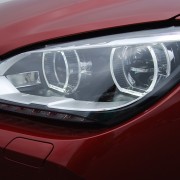
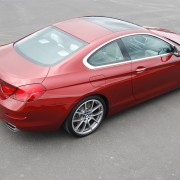
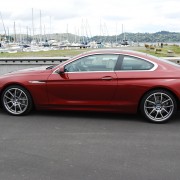
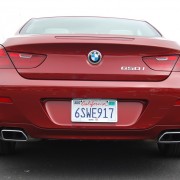
BMW 650i Coupe Review 2012

Posted by Blogger Kingdom 0 comments


By David Colman
For: Do-It-All Nature, Space, Grace, Pace
Against: Exterior Rear View Mirrors Too Small
If you need a sportscar and a high performance sedan, look no further than Bimmer’s 650i. Granted, it’s a tad pricey at $101,675. But if you perceive it as 2 cars in 1, you’re on the right reasoning track. If you’re willing to alot $50,000 for each purpose the 650i fulfills, then you’ve saved yourself from buying an extra car. Let’s examine this genteel beast from the sportscar perspective first. Are 400hp and 450 lb.-ft. of torque enough to slake your thirst for V8 twin turbo power? They should be, considering the 650i will turn 107mph in 13.4 seconds through the quarter mile, and post a 0-60mph time of 5.1 seconds on its way to an electronically limited top speed of 150mph. If that isn’t serious sportscar territory, than nothing is.
But what about the handling? In a word, superb. BMW’s Driving Dynamics Control (DDC) system, which is standard on this car, allows you to dial up just the right amount of steering feedback, suspension control, throttle response and traction control permissiveness you need when pushing the performance envelope. An easily accessible button on the standard “Fine Line Oak Wood” center console allows you to bump the default DDC setting from Comfort to Performance or Performance+. If you hold the button down for 10 seconds in the Performance+ setting, you disable Dynamic Stability Control (DSC), putting your enthusiasm and talent in control of the situation. You’ll want to be exceptionally careful in this DSC-deleted Performance+ mode, because many of the safety net override systems are disabled, making it possible to lose control of this heavy and powerful vehicle if you don’t know what you’re doing.
 
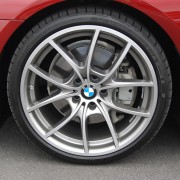
Even though it weighs 4,380 pounds, the 650i feels much more agile than its weight would lead you to believe. That’s because a number of optional systems work in consort seemingly to defy the limits imposed by mass and gravity. Leading the way is Integral Active Steering ($1,750) which really translates into 4-wheel-steering. As you enter a turn, the rear wheels cock slightly in the direction of the turn to augment the adhesion of the huge 20 inch diameter alloys and Dunlop Sport Maxx run-flat DSST tires (245/35/20 front, 275/30/20 rear) which are standard on this model. At 37mph, rear wheel steering turn entry enhancement ends. Further aiding handling agility is the ingenious Active Roll Stabilization ($2,000), which tailors anti-sway bar tension according to need. The faster you drive, the stiffer the sway bars become.
Now let’s examine this coupe’s contribution to family harmony. Although access to the rear seats is by definition limited in any 2-door vehicle, this BMW does its best to make back seat usage feasible and comfortable for all concerned. An oversized latch on the top of the front seats allows back seaters to tilt their way into the plush pair of rear lounge chairs. Even better are the exquisitely crafted front 20-way power Multi-contour chairs, complete with Nappa leather covering and optional ($500) 3-stage heaters. The commodious 16.1 cubic foot trunk, unencumbered by the need to house a spare tire thanks to the run=flat Dunlops, will hold enough baggage to take three adults and their suitcases across country. And what a fine trip it promises to be. On the open highway, the twin turbo V8 settles into a relaxed gate that nets you 23 MPG. Slip the Dynamic Driver Control system into Comfort+ mode, and the 650 metamorphoses from a backroad burner to a freeway cruiser extraordinaire. The optional Bang & Olufsen Premium Sound Package ($3,700) provides an endless array of entertainment options, from 1 year of free Sirius Radio to iPod and USB integration. So if you need a concert hall on wheels with the ride comfort of a ‘60s Cadillac, then give this Bimmer a close look. Because it’s the very same car that will run with a Turbo Porsche on any backroad of your choice.

2012 BMW 650i Coupe
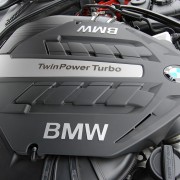
  • Engine: 4.4 liter V8, Direct Injected and Twin Turbocharged
  • Horsepower: 400hp at 5,500rpm
  • Torque: 450lb.-ft. at 1,750rpm
  • Fuel Consumption: 15 MPG City/23 MPG Highway
  • Price as Tested: $101,675
  • Star Rating: 9.5 out of 10 Stars
2012 BMW 650i Coupe2012 BMW 650i Coupe2012 BMW 650i Coupe

2012 BMW 650i Coupe2012 BMW 650i Coupe2012 BMW 650i Coupe2012 BMW 650i Coupe2012 BMW 650i Coupe2012 BMW 650i Coupe

Posted by: D.Colman

BMW X5 2011 - A New Face and 400-hp Twin-Turbo Motivation

Posted by Blogger Kingdom 0 comments

While BMW spent last year adding upgraded engines to its lineup, the X5 sat untouched, forced to enjoy only the 3.0-liter diesel found in the xDrive35d. A potent mill, yes, but the other Bimmers received a more efficient, single turbo inline-six; if they didn't, more power came to their twin-turbo setup. A 400-horsepower twin-turbo V-8 headlined the X6, while the M versions of the X6 and the X5 boasted a silly 555-horsepower. Now, the standard X5 gets its turn. Along with an exterior refresh, the 2011 BMW X5 receives two new powertrains.
2011 BMW X5 Rear In Watear the_car_review_bmw_x5
At the top of the hierarchy is the X5 xDrive50i, which features BMW's all-aluminum, twin-turbo V-8. With direct injection, variable valve timing, and its "reverse flow" setup (the turbochargers rest in the valley between the cylinders), the engine makes 400-horsepower and 450 pound-feet of torque, the latter from 1750 rpm to 4500 rpm. Similar to the X6, BMW claims that acceleration to 60 mph in the X5 xDrive50i takes 5.3 seconds. Yet the X5 undercuts the current Sports Activity Coupe by $8800 by starting at $59,275.
2011 BMW X5 Side
Underneath the V-8 is the xDrive35i. It receives the 3.0-liter single-turbo straight-six (known internally as N55) that has been replacing most twin-turbo mills in the BMW line. It should be no surprise that the engine makes 300 horsepower and 300 pound-feet of torque, but, interestingly, its 0-60 mph claim of 6.4 seconds matches that of the outgoing, V-8-powered xDrive48i. The xDrive35i starts at $46,675.
Both engines come attached to the same eight-speed automatic that BMW introduced on the 5 Series Gran Turismo and 760Li Sedan last year. It weighs no more than the replaced six-speed, BMW says, and the transmission offers closer ratios in the lower gears for improved acceleration and two tall gears for cruising. Both engines also gain brake energy regeneration, which disengages the alternator so that the deep-cycle Glass Mat battery only charges during coasting or braking. BMW says this technology is good for a 1-2 percent fuel consumption savings.

By Carlos Lago

BMW 335is Coupe 2011 - First Drive Review

Posted by Blogger Kingdom 0 comments
To fill the gap in the 3-series lineup between the 300-hp 335i and 414-hp M3, BMW is introducing the 2011 335is coupe and convertible. We were unaware that said gap needed to be filled, but we’re told that the 335i is seen in the U.S. as just an ordinary 3-series, and as such, there’s room for something more exotic than a 335i but less outlandish than an M3. Now that we’ve been given the chance to drive the 335is coupe, we’re coming around to accepting this whole gap idea.

More Power and a Body Kit and . . .

Conceptually similar to the 330i Performance package model that was available as part of the previous-generation 3-series lineup, the 335is doesn’t go so far as to threaten the M3’s supremacy, but it definitely ups the sportiness quotient. To that end, the 335is gets 320 hp and 332 lb-ft torque from the twin-turbo 3.0-liter inline-six engine, and an overboost function allows for seven-second blasts of 370 lb-ft of torque. Unlike the regular-grade 2011 335i, the 335is sticks with the older twin-turbo engine for the simple reason that BMW engineers had more experience tuning it. This same engine can also be found in the Z4 sDrive35is that was introduced at this month’s Detroit auto show. In the Z4, the engine makes 335 hp; a more restrictive intake on the 3-series accounts for the 15-hp difference.

To make the 335is a track-worthy vehicle, BMW upgrades the cooling system with an additional radiator and beefs up the engine mounts. Inside are standard sport seats, steel pedals, an M Sport steering wheel, and textured aluminum trim. Between the seats sits the familiar six-speed manual, but it’s modified here to have shorter throws. For those who prefer not to shift for themselves, BMW is offering its seven-speed dual-clutch gearbox. The DCT system is identical to the one in the M3 and comes with steering-wheel-mounted paddle-type shifters.

Exterior styling builds on that of the 3-series’ 2011 freshening and adds an aggressive M Sport body kit. The kit has a more aggressive front fascia that ditches the coupe’s fog lamps in the interest of increased cooling capacity; the 335is convertible keeps its fog lamps. (And just to confuse you, we posted photos of preproduction coupes with fog lights; the decision to ditch them apparently came after these cars were built.) A new rear bumper incorporates a diffuser-style piece, and the twin exhaust pipes are finished in matte black. New gray-painted, split-five-spoke wheels are the only change to the chassis, despite the extra power—there are no tweaks or modifications to the suspension or brakes.

Same Poise, Even Better Soundtrack

Immediately on starting the engine, one detects a more noticeable hum from the new exhaust system. Less-restrictive mufflers snarl menacingly and only get angrier once the throttle is matted and the revs rise. As we’ve seen with other applications of the twin-turbo six, power is delivered with the immediacy of a large-displacement, naturally aspirated engine. The extra horsepower bestowed on the 335is isn’t exactly massive, but the car will still quickly shrink a straightaway, and it rockets into triple-digit speeds as if towed by a Boeing 747. Indeed, a few laps around Portugal’s Estoril racetrack revealed this car to be exactly what’s suggested by the spec sheet: a powerful 3-series with a fantastic soundtrack. As one might expect from the carry-over chassis, the balance, the predictability, and the unflappable poise that make the 3-series one of our favorite cars are all there in spades.

The 335is doesn’t exactly threaten the M3 performance-wise, and with a starting price of $50,525, the 335is coupe costs $8750 less than an M3 coupe. But compared with the M3 sedan, the 335is coupe saves only $5750; faced with that choice, we’d pony up for the four-door M3. Convertible versions of the 335is start at $59,075, or $8850 less than the M3 convertible. The 335is convertible will arrive in April; coupe buyers will have to wait until June. And don’t go looking for the 335is at dealerships outside North America; for once, BMW is building something just for us.


Specifications

TRANSMISSIONS: 6-speed manual, 7-speed dual-clutch automated manual

DIMENSIONS:
Wheelbase: 108.7 in Length: 181.9 in
Width: 70.2 in Height: 54.1 in
Curb weight: 3650–3750 lb

PERFORMANCE (C/D EST):
Zero to 60 mph: 4.5–4.8 sec
Standing ¼-mile: 13.2–13.5 sec
Top speed (governor limited): 155 mph

FUEL ECONOMY (MFR'S EST):
EPA city/highway driving: 17/26 mpg

(BY TONY QUIROGA )

BMW M3 2008- Baubles and Bolt-Ons

Posted by Blogger Kingdom 0 comments

A car has got to be pretty spectacular to win over the curmudgeons here at 1585 Eisenhower Place, especially when familiarity sets in over the course of 40,000 miles. But our Sparkling Graphite Metallic M3 did indeed win us over. For less than $70,000, the M3 bolts from a standstill to 60 mph in 4.3 seconds and turns the quarter-mile in 12.7 seconds at 113 mph. It pulls an exceptional 0.96 g on the skidpad, stops in 147 feet from 70 mph, and reaches a governor-restricted 161 mph. On a racetrack or a back road, it’s a beautifully balanced and hugely entertaining machine.

Aside from performance, the M3 is comfortable on the highway and has plenty of space for four adults. It has a full complement of luxury accouterments and yet is very practical—even the trunk is commodious. It has muscular, raked looks and a handsomely dark interior. A bonus is that regular service doesn’t cost a cent, thanks to BMW’s full-maintenance program, which lasts for four years or 50,000 miles. (The gas bill, however, wasn’t cause to rejoice, given this BMW’s 17-mpg thirst.)

When it came to ordering the car, we went with the so-called M double-clutch transmission (M DCT), a $2700 option that replaces the standard six-speed manual with a seven-speed dual-clutch unit, BMW’s first. We were eager to try this setup because dual-clutch transmissions promise the smoothness of an automatic when the driver can’t be bothered to change gears, as well as superfast paddle shifts in manual mode. In the previous M3 (E46), BMW offered a single-clutch, automated manual gearbox that was notable for its harshness in manual mode and its clunkiness as an automatic.

Other options included the $750 Cold-Weather package, a godsend in Michigan winters; the $3250 Technology package that dumps navigation in with electronic adaptive dampers; 19-inch wheels and tires ($1200); and the $1900 Premium package that bundles power folding mirrors and Bluetooth interface along with upgraded leather interior trim that has a distinctive carbon-fiber look.

The interior held up well, but the side of the driver’s seat got scuffed up. Rear-seat space was decent.

Who wouldn’t react favorably to a perform ance car so well rounded? Here’s who: some whiners on staff anxious to get past the 1200-mile engine-break-in period, during which BMW suggests that drivers never use full throttle and refrain from revving higher than 5500 rpm. Once past this period, our crew was fulsome in its praise for the BMW’s everyday drivability—although it pays to keep the variable shocks on their softest setting on poor pavement. We even noted relatively few iDrive complaints, at least until the knob that controls it became loose at 37,000 miles. (It was replaced under warranty, without charge.) BMW has since changed the iDrive interface, and the new setup is far easier to operate. Those who plugged iPods into the M3 were satisfied with the interface between tunes and car.

We always plan for snow in the winter, so at 19,903 miles, we installed a set of Pirelli Winter 240 Sottozero tires on the base 18-inch rims. We racked up 10,500 miles on these tires, during which the M3 proved quite adept at getting around despite all the white stuff that fell in Michigan last winter and spring. The car also rode better on the 18s, although most drivers felt the decrease in ride quality with the 19-inch wheels was worth it for the improved looks.

Spot the missing iDrive knob . . .

The service history was fairly uncomplicated, and with the free regular maintenance, the only out-of-pocket cost for 40,000 miles was $1450 for new tires. Based on our experience, the stock Michelin Pilot Sport PS2s should last roughly 25,000 miles for the rears and 35,000 for the fronts. As for service, after an initial 1200-mile stop to replace the engine oil and the transmission and differential fluids, the BMW’s onboard computer determines the service schedule. It prompted us at 16,210 (engine-oil change), 27,769 (various inspections), and 29,248 miles (engine-oil change).

Due to an oversight, the M3 arrived at our offices without satellite radio installed, so we decided to add Sirius pay-radio service in the car at 13,264 miles—the unwed among us were suffering Howard Stern deprivation—which cost $245 for wiring and programming.

At the 27,769-mile service stop, the M DCT transmission was reprogrammed as part of a service bulletin that resulted from the “sudden loss of engine power when decelerating to a complete stop with light brake application.” M3 forums describe the sensation as being akin to the car stalling due to the transmission holding a higher gear than appropriate. In any event, this mechanical foul-up never bit us.

Over the M3’s long stay, several drivers banged up the perilously low frontal underbody against curbs, inclined driveways, and irritating parking-lot barriers, to the point that we had to replace the engine splash shield and other underbody parts at a cost of $501. Other than this, the car’s exterior (and interior) held up extremely well over its 17 months with us.

The only significant complaints involved the dual-clutch transmission. In automatic mode, it works remarkably well, and it was hard not to be awed by the speed of the shifts and its smoothness of operation. Indeed, technical director Dave VanderWerp observed that it “upshifts so smoothly under part throttle that it’s easier to detect a shift from the change of the exhaust note than it is to feel it. Too bad,” he went on, “that the lazy throttle tip-in from standstill is so off-putting.”

And near the end, the dual-clutch transmission was making clunks and groans. Assistant tech editor K.C. Colwell was adamant that the transmission had loosened up considerably. Twice while the M3 was parked facing downhill, the transmission slipped markedly when the driver was trying to back up. If the clutches need to be replaced, our local dealer quoted us $3296 for the job! So far, none of the M3 forums has reported any issues with M DCT, save for the service bulletin already mentioned. Indeed, most owners seem besotted with the dual-clutch gearbox.

Most of the sentimental drivers on staff would have preferred a manual transmission in the M3, although the automatic function of the M DCT is good for mindless commuting. All around, this M3 was a far better experience than our long-term E46 M3 [March 2003]. Not only is the M3 dramatically improved in acceleration, braking, and skidpad grip, but it was utterly dependable. That 2001 M3 burned through 14 quarts of oil and used to sputter, stumble, and often stall on cold winter mornings. This M3 needed just two remedial quarts, the first of which wasn’t added until 25,000 miles, and the car held a steady idle on even the bitterest cold starts. Based on our experience, the current M3 is the world’s all-around best car for the money, although several staffers would have preferred to trade some of the coupe’s looks for the added practicality of the sedan. Choices, choices

RANTS AND RAVES

K.C. Colwell

This is the finest car on the market, period.

Russ Ferguson

The slow-speed launch can really suck. One auto-shop teacher accelerated very gingerly and got the M3 to buck and hitch like a 16-year-old learning to drive a manual.

Sara Quiroga

My only complaint about this car is that I don’t own it.

Mike Dushane

The dual-clutch transmission short-shifts at the slightest hint of wheelspin in automatic mode. Very annoying. I wind up driving in manual mode all the time, so why not save money and get the manual?

Steve Spence

Very grouchy sometimes in responses to the throttle. And that’s about the only negative to this great, great car.

Tony Quiroga

The M3 didn’t work very well in deep snow—and the winter tires did little to help. But in snow less deep, the M3 tracked beautifully and worked remarkably well.

Track Tires

Here are two truths about self-respecting M3 coupe owners: They would not even consider the optional sunroof that eliminates the distinctive carbon-fiber roof, and it’s likely they will end up driving their cars at a racetrack. That second sure thing happened to us as pseudo-owners, and after a handful of laps we’d obliterated the tread on the stock Michelin Pilot Sport PS2 tires. They simply can’t cope with the amount of heat generated by this 3600-pound thrill machine at its flaming limits.

So we went looking for stickier, street-legal track tires—commonly referred to as “R compound”—but finding them in either the M3’s standard 18-inch size or the optional 19-inch dimension was difficult. However, Michelin has one, a BMW-specific version of its Pilot Sport Cup tires, in only the 19-inch size. In fact, these tires originated with the Euro-only, lightweight CSL edition of the previous-generation M3.

Available only as a replacement tire, this “Sport Cup +” version (fronts, $353 each; rears, $416) features additional grooving in the tread, which compromises stiffness to be friendlier in the rain (which it is) compared with an off-the-shelf Sport Cup. And these tires are also able to withstand higher temperatures than the stock PS2s. Unfortunately, skidpad results were no better with the Sport Cups (0.96 g), and braking (156 feet) was a bit worse.

On a racetrack or a back road, it’s a beautifully balanced and hugely entertaining machine.

We returned to the 1.9-mile GingerMan Raceway in South Haven, Michigan, where we’d chewed up our stock tires, with much improved results. Although it didn’t feel like there was a whole lot more stick in the corners (our best time was a 1:38.1), more important, lap times remained consistent. But after almost 1000 street miles and a couple of dozen hard laps at GingerMan, the fronts (see photo) had 2/32nds of an inch of tread left. The rears fared better, only burning through half (3/32-inch) of their tread. Even though the BMW-specific Sport Cups didn’t outgrip the PS2s, having a tire that’s consistent and lasts significantly longer during abusive lapping is indeed a boon for the track-rat M3 owner.

BMW 740i / 740Li - AutoReview 2011

Posted by Blogger Kingdom 0 comments
Americans will finally see a rational application of BMW’s Euro-centric EfficientDynamics mantra when BMW unveils six-cylinder versions of its 7-series at the Detroit auto show in January. The 740i will occupy the lowest rung on the company’s executive-sedan ladder, below the plenty-powerful 750i, the extreme 760i, and the slightly ridiculous ActiveHybrid 7.

Power comes from BMW’s twin-turbo inline-six, which in this application makes 315 hp at 5800 rpm and 330 lb-ft of torque at a low 1600 rpm. Keeping track of BMW’s turbocharged sixes is becoming more complicated by the day; this represents a higher state of tune than the 300-hp twin-turbo version used in the 1-, 3-, and 5-series, which is separate from the high-output, 335-hp version recently announced for the Z4 sDrive35is, which is also different from the new single-turbo unit that also makes 300 hp and is debuting in the 5-series GT this spring. The engine will be backed by a six-speed automatic in the 7-series. The sixed 7 will look just like its V-8 siblings and will likewise be offered with a short (740i) or long (740Li) wheelbase as well with the full menu of packages and standalone options.

If we’re going to have to deal with downsized engines, at least the one sliding into the 7 is a sweetheart, and this car sure does make a lot more sense than the ActiveHybrid 7. Fuel economy hasn’t been disclosed, but we can safely expect mileage slightly better than the 15 mpg city/22 highway that the twin-turbo V-8 750i achieves, but not quite as good as the 535i’s 17/26 ratings. Let’s say maybe 16/24.

When the models launch in the spring of 2010 as 2011 models, it will have been 19 years since the U.S. was offered a six-cylinder 7. Mercedes hasn’t sold a six-cylinder S-class since the end of the car’s last generation, so, at least for now, the 7-series will own the six-cylinder (non-hybrid) luxury-sedan market.

(BY DAVID GLUCKMAN )

BMW 5-series of new F10 (2010)

Posted by Blogger Kingdom 0 comments
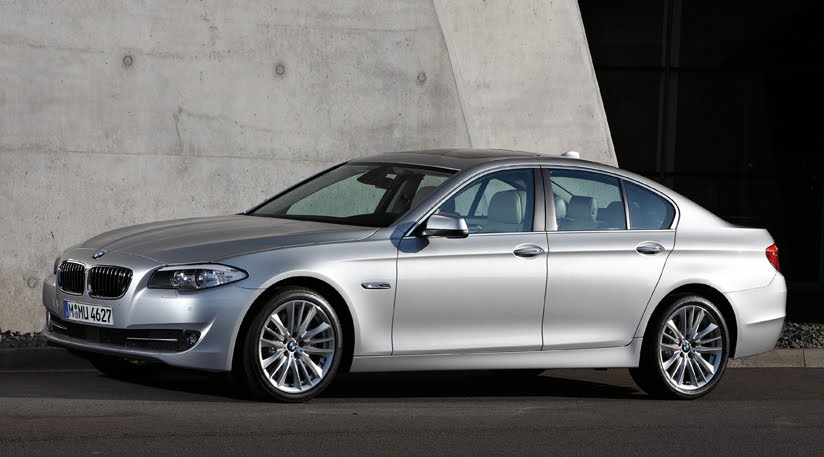
The BMW 5-series saloon – it’s finally here. Internally dubbed F10, it's the sixth-generation BMW 5-series and will be unveiled at the Geneva motor show in spring 2010, with UK sales starting on 20 March 2010. A 5-series Touring version (F11) will follow next September.

So what’s new for the sixth-generation BMW 5-series?

Let’s start with the tech: BMW claims the new 5-series is the first car in its class to feature start-stop tech, an eight-speed automatic transmission and double wishbone front suspension.

The new 5-series is also the first BMW to get the company's new Park Assist tech, slotting the car into a space by twiddling the wheel, leaving the driver to operate on the accelerator and brake pedals. A bit like a VW Touran, then.

Will the new 2010 Five still be the sporty choice of exec?

The double wishbone front suspension is mated to a rear multilink set-up, and BMW's optional Drive Dynamic Control chassis system offers Comfort, Sport and Sport+ damper settings. Four-wheel active steering can also be specced, along with a Surround View camera system, a head-up display, night vision with pedestrian recognition, lane departure and lane change warning systems, plus speed limit detection.

Unfortunately, start-stop tech is only available on the manual 520d, and won't be available on the new eight-speed auto until later. Although the electric power steering will reduce fuel consumption, we don't expect it to endow the new 5-series' steering with exceptional feel.

And whereas the current-gen Five features an aluminium front end mated to a steel rear, the new car is all steel. Nevertheless, BMW still claims the new car achieves a 50:50 weight distribution.

(By Ben Pulman,First official pictures)

BMW’s one-off M5

Posted by Blogger Kingdom 0 comments
This is a one-off BMW M5 with close to 600bhp. Built to commemorate the 25th anniversary of BMW’s iconic M5 super-saloon, it’s a stripped-out lightweight special that shows what M Division could have done if it hadn’t built the X5 M and X6 M.

Details, quickly please! I’m slobbering over this new BMW M5 already!

Let’s start with the engine. As if the 500bhp/384lb ft 5.0-litre V10 wasn’t incredible enough, BMW’s M Division has stroked it out to 5.5-litres. Add in a new carbonfibre manifold and the outputs have risen to over 580bhp and nearly 400lb ft.

And to cope with that extra power BMW has junked the sequential-manual gearbox and brought in a beefed-up version of the M3’s seven-speed dual-clutch M DCT ‘box.

Inside the gearbox is linked to a pair of paddles, while the driver and front-seat passenger sit in new carbonfibre-backed buckets. There’s also a new carbonfibre roof – that cleaves a claimed 50kg of the E60 M5’s 1855kg kerbweight – and the rear seats have been junked. There’s also been a tweak to the specification of the adaptive suspension.

Bar M Division’s triple-stripe colour scheme, and some stickers celebrating 25 years of the M5, this one-off looks little different to the standard car. The only visual clue is the offset number plate, which makes way for an new intake that feeds air to the extra oil cooler.

Expect this special E60 M5 to hit 62mph in close to four seconds, and easily top 200mph. We also hear it’ll lap the Nurburgring in under eight minutes, a comfortable 20 seconds or so quicker than the standard car.

But BMW isn’t going to produce this, so we’ll just have to wait for the new twin-turbo V8 M5.


(By Ben Pulman, First official pictures)

BMW’s one-off M5

Posted by Blogger Kingdom 0 comments
This is a one-off BMW M5 with close to 600bhp. Built to commemorate the 25th anniversary of BMW’s iconic M5 super-saloon, it’s a stripped-out lightweight special that shows what M Division could have done if it hadn’t built the X5 M and X6 M.

Details, quickly please! I’m slobbering over this new BMW M5 already!

Let’s start with the engine. As if the 500bhp/384lb ft 5.0-litre V10 wasn’t incredible enough, BMW’s M Division has stroked it out to 5.5-litres. Add in a new carbonfibre manifold and the outputs have risen to over 580bhp and nearly 400lb ft.

And to cope with that extra power BMW has junked the sequential-manual gearbox and brought in a beefed-up version of the M3’s seven-speed dual-clutch M DCT ‘box.

Inside the gearbox is linked to a pair of paddles, while the driver and front-seat passenger sit in new carbonfibre-backed buckets. There’s also a new carbonfibre roof – that cleaves a claimed 50kg of the E60 M5’s 1855kg kerbweight – and the rear seats have been junked. There’s also been a tweak to the specification of the adaptive suspension.

Bar M Division’s triple-stripe colour scheme, and some stickers celebrating 25 years of the M5, this one-off looks little different to the standard car. The only visual clue is the offset number plate, which makes way for an new intake that feeds air to the extra oil cooler.

Expect this special E60 M5 to hit 62mph in close to four seconds, and easily top 200mph. We also hear it’ll lap the Nurburgring in under eight minutes, a comfortable 20 seconds or so quicker than the standard car.

But BMW isn’t going to produce this, so we’ll just have to wait for the new twin-turbo V8 M5.


(By Ben Pulman, First official pictures)

BMW 7-series ActiveHybrid 7 2009

Posted by Blogger Kingdom 0 comments
How very BMW. The new ActiveHybrid 7 – Munich's name for its petrol-electric hybrid 7-series – is very much lodged at the top of the Seven family tree. Not for BMW to launch a sackcloth and sandals 7-series hybrid; this one sports a 4.4-litre V8, not one but two turbochargers and a 0-60mph sprint claim to worry many Porsches.

We lost count of the number of times BM execs stood up at the press conference and talked about 'driving pleasure' and 'performance'. This paints a clear backdrop to the ActiveHybrid 7's intent. Yes, CO2 and economy are better by nearly a fifth over the regular 750i donor, but they're hardly going to win you honorary membership of Greenpeace at 219g/km and 30.1mpg.

So the BMW ActiveHybrid 7 is dirtier than a 730d or 740d?

Err, yes. But a diesel 7-series wouldn't see which way the hybrid Seven went in a drag race. Thanks to a compact electric motor built into the ZF eight-speed auto transmission, the ActiveHybrid 7 is relentlessly torquey and feels every second as fast as its sub-5.0 second sprint credentials suggest.

The electric motor is rated at 15kW or 19bhp – relatively small fry in the new world order of battery cars. But this is a mild hybrid, don't forget. Unlike the fully hybridised X6 ActiveHybrid, the 7-series isn't required to lug its substantial 2120kg girth on electric motion alone. It's more about tuning the drivetrain for ballistic thrust while still giving a nod to those demanding green emissions.

And why exactly is the ActiveHybrid 7 clean?

The engineers have tuned this car to shift up into top – eighth gear – at the earliest possible opportunity. You can barely hear the V8 most of the time until you acquaint pedal with bulkhead. The electronics then feed in battery power to create a tsunami of 516lb ft all the way from 2000-4500rpm.

Boy do you feel this on the road. There you are surfing along on a surfeit of torque, wafting past slower-moving traffic in refined peace. Kickdown and you're thrust back into your comfy 7-series seats in shocked awe. It's epically fast. My only gripe is that you never feel the full hybrid 'halo' effect of silent motion – a shortcoming shared by any mild hybrid.

At least the petrol engine cuts out at a standstill, saving petrol and allowing you a smug glow as you sit in saintly silence at traffic lights.

BMW 7-series ActiveHybrid 7 2009

Posted by Blogger Kingdom 0 comments
How very BMW. The new ActiveHybrid 7 – Munich's name for its petrol-electric hybrid 7-series – is very much lodged at the top of the Seven family tree. Not for BMW to launch a sackcloth and sandals 7-series hybrid; this one sports a 4.4-litre V8, not one but two turbochargers and a 0-60mph sprint claim to worry many Porsches.

We lost count of the number of times BM execs stood up at the press conference and talked about 'driving pleasure' and 'performance'. This paints a clear backdrop to the ActiveHybrid 7's intent. Yes, CO2 and economy are better by nearly a fifth over the regular 750i donor, but they're hardly going to win you honorary membership of Greenpeace at 219g/km and 30.1mpg.

So the BMW ActiveHybrid 7 is dirtier than a 730d or 740d?

Err, yes. But a diesel 7-series wouldn't see which way the hybrid Seven went in a drag race. Thanks to a compact electric motor built into the ZF eight-speed auto transmission, the ActiveHybrid 7 is relentlessly torquey and feels every second as fast as its sub-5.0 second sprint credentials suggest.

The electric motor is rated at 15kW or 19bhp – relatively small fry in the new world order of battery cars. But this is a mild hybrid, don't forget. Unlike the fully hybridised X6 ActiveHybrid, the 7-series isn't required to lug its substantial 2120kg girth on electric motion alone. It's more about tuning the drivetrain for ballistic thrust while still giving a nod to those demanding green emissions.

And why exactly is the ActiveHybrid 7 clean?

The engineers have tuned this car to shift up into top – eighth gear – at the earliest possible opportunity. You can barely hear the V8 most of the time until you acquaint pedal with bulkhead. The electronics then feed in battery power to create a tsunami of 516lb ft all the way from 2000-4500rpm.

Boy do you feel this on the road. There you are surfing along on a surfeit of torque, wafting past slower-moving traffic in refined peace. Kickdown and you're thrust back into your comfy 7-series seats in shocked awe. It's epically fast. My only gripe is that you never feel the full hybrid 'halo' effect of silent motion – a shortcoming shared by any mild hybrid.

At least the petrol engine cuts out at a standstill, saving petrol and allowing you a smug glow as you sit in saintly silence at traffic lights.

BMW C.L.E.V.E.R. Concept

Posted by Blogger Kingdom 0 comments
BMW just released official pictures of its co-developed three-wheeled, natural-gas powered micro-car called CLEVER (Compact Low Emission VEhicle for URban Transport). Although nothing official yet, but this concept that was funded by the European Commission (Fifth Framework Programme) could base the C1 successor, marrying the worlds of cars and motorcycles. Partners in the C.L.E.V.E.R project included:
  • BMW
  • Technical University of Berlin, Institute for Land and Sea Transport (TUB), Berlin, Germany
  • Cooper-Avon Tyres Ltd, Melksham, Great Britain
  • ARC Leichtmetall Kompetenzzentrum Ranshofen GmbH (LKR), Ranshofen, Austria
  • IFP
  • TAKATA-PETRI AG, Berlin, Germany
  • University of Bath, Department of Mechanical Engineering, Institute for Power Transmission and Motion Control, Bath, Great Britain
  • Universität für Bodenkultur Vienna, Institute of Transport, Vienna, Austria
  • WEH GmbH, Illertissen, Germany

The CLEVER concept, a €3.3 million (US$3.9 million) effort, is an enclosed two-seater that combines the safety of a microcar, and the maneuverability of a motorcycle, while being less polluting than other vehicles as it runs on compressed natural gas.


Its strengthened frame will protect the driver in a crash and the vehicle will have a top speed of approximately 50 mph. The 230cc BMW engine—modified by Institut Français du Pétrole (IFP) to use natural gas—produces 12.5 kW (17 hp) of power and maximum torque of 15.5 Nm at 6,300 rpm.

Fuel consumption is estimated to be 2.4 liters/100 km gasoline equivalent (98 mpg US), with 59.5 g/km of CO2 emissions. The compressed natural gas is stored in two removable gas bottles providing a range of 150 km (93 miles).

A problem with three-wheel vehicles with a symmetrical wheel layout is the tipping moment when cornering, which cannot be controlled at high speeds if the vehicle has a short wheelbase. To solve this problem the vehicle’s center of gravity can be moved towards the center of the corner—just as a motorcycle does when it corners.

The do this, the vehicle is a cabin tilter, with the system designed by the University of Bath. The cabin with the front wheel is connected to the power unit and the two rear wheels by a pivot bolt. The rotary movement of the cabin is produced by two hydraulic cylinders (actuators) that are installed between the cabin and the power unit. The actuators create the rotary angle of the cabin of +/-45° relative to the vertical power unit.

Technorati Tags: , , , , , , ,